History

Sagrada Família history: from 1882 and Gaudí to today

Construction of Sagrada Família began in 1882, and Antoni Gaudí wasn't its first architect. He took over in 1883 and turned a conventional neo-Gothic church into the basilica Barcelona knows today. He worked on it for 43 years, gave it his whole working life from 1914, and died in 1926 with only a fraction built. The project survived the destruction of his drawings and models in the Spanish Civil War, sped up in the late 20th century, and in 2026 the exterior of the 172.5-metre Tower of Jesus Christ was completed.

Last checked November 2026

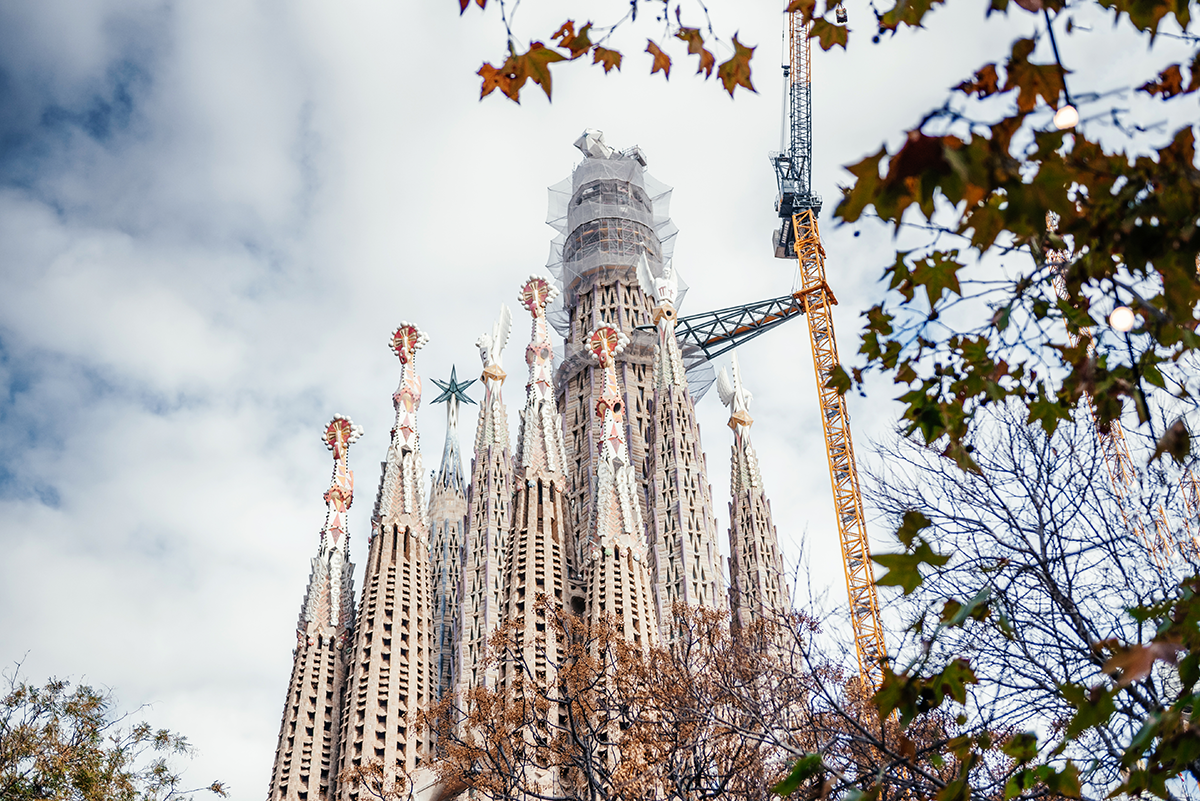
Sagrada Familia's spires rising above Barcelona with construction still under way

Begun 1882 · Gaudí from 1883

Gaudí died 1926 · consecrated 2010 highest tower completed 2026, at 172.5 m

Step inside Sagrada Família and it can look almost unreal: a forest of branching stone columns, deeply coloured stained glass, and towers unlike anything else in Barcelona. What you are looking at is more than 140 years of architectural history in one building.

The church began before Gaudí was involved. He inherited someone else's project, redesigned it almost beyond recognition, knew he would never see it finished, and deliberately left enough models and plans for later architects to carry on. Then came his death, civil war, a wrecked archive, decades of reconstruction and, in the end, computer modelling and prefabrication that let builders tackle shapes Gaudí worked out long before the technology existed.

Knowing that story makes a visit far more interesting. The oldest stone, the Nativity façade, the stark Passion façade and the new central towers are different chapters of a building project spanning five generations.

The detail that changes how you see it

The richly carved Nativity façade is the part closest to the building Gaudí actually knew. Much of the soaring interior and almost all of the central skyline were built decades after his death.

At a Glance

Sagrada Família history at a glance

The dates below follow the Basilica's own construction chronology.

YearWhat happened
1866Josep Maria Bocabella founded the religious association that would go on to promote the church
1882The cornerstone was laid and construction began under architect Francisco de Paula del Villar
1883Antoni Gaudí took over the project
1885The first Masses were celebrated in the crypt
1891Work on the Nativity façade began
1914Gaudí stopped taking other commissions and worked only on Sagrada Família
1925The Saint Barnabas bell tower on the Nativity façade was completed, the only one Gaudí saw finished
1926Gaudí died
1936During the Spanish Civil War his workshop was attacked: drawings and photographs were burned and plaster models smashed
1939Francesc de Paula Quintana took over, working from salvaged and reconstructed models
1954The foundation of the Passion façade was laid
1976The four Passion façade bell towers were completed
1986Josep Maria Subirachs was commissioned for the Passion façade sculpture, and foundation work on the nave began
2005The Nativity façade and crypt became part of a UNESCO World Heritage Site
2010Pope Benedict XVI consecrated the church and named it a minor basilica
2016Work began on the six central towers
2021The Tower of the Virgin Mary was completed
2022–23The four Evangelist towers were completed
2026The exterior of the Tower of Jesus Christ was completed, at 172.5 metres

Hear the Story Inside

Seeing the history with a guide

Much of this story is only visible once someone points it out: which stone Gaudí saw laid, where the models were rebuilt, why the two façades look like different buildings. The Sagrada Familia Priority Access Guided Tour spends about 1.5 hours on Gaudí's life, the hidden meaning in his details and the history of the unfinished basilica, and includes the museum, where his original sketches are on display (4.8/5 from 6,433 reviews, from £55, in English). Entry can be delayed in high season and parts of the Basilica sometimes close for events, so check your date below.

Pоwered by GetYourGuide

Before Gaudí

The story begins before Gaudí

It is easy to imagine Gaudí deciding one morning to design Sagrada Família. He didn't.

The origins go back to 1866, when the bookseller and religious publisher Josep Maria Bocabella i Verdaguer founded the Spiritual Association of Devotees of Saint Joseph. By the 1870s the association was promoting the idea of an expiatory temple dedicated to the Holy Family: a church paid for by voluntary offerings, not commissioned and funded by the government or a wealthy patron.

In 1881, donations allowed the association to buy a plot of about 12,800 square metres on what was then the growing edge of Barcelona. It was bounded by Mallorca, Marina, Provença and Sardenya streets, the same block the Basilica fills today.

A church that began in open ground

That last detail is easy to miss on a visit. Today the Basilica is wrapped in the dense streets of the Eixample. In the late 19th century this part of the city was much less built up, so the church that now feels wedged into central Barcelona first rose from fairly open land.

1882

1882: construction begins

Sagrada Família's official birthday is 19 March 1882, the feast of Saint Joseph, when Barcelona's bishop, José María de Urquinaona, laid the cornerstone.

The first architect was Francisco de Paula del Villar, not Gaudí. Villar planned a fairly conventional neo-Gothic church with the features typical of the period:

  • pointed arches
  • Gothic-style windows
  • buttresses and flying buttresses
  • a tall pointed bell tower

Construction started with the crypt beneath the apse. Disagreements over technical matters and the cost of materials followed, and Villar left the project. That opened the door for a young architect whose ideas were anything but conventional.

1883

1883: Antoni Gaudí takes over

Antoni Gaudí became Sagrada Família's architect in 1883, at 31. The crypt foundations were already laid and some columns partly built, so he wasn't starting from an empty site.

At first Gaudí worked within the existing plan. Then his ambitions grew, and instead of finishing Villar's neo-Gothic church he gradually reinvented almost everything above the crypt. The building would eventually include:

  • 18 towers for Jesus Christ, the Virgin Mary, the four Evangelists and the twelve Apostles (see how the design works)
  • three monumental façades showing the Nativity, Passion and Glory of Christ
  • a vast interior conceived like a stone forest, on branching columns
  • complex geometric vaults and abundant sculpture
  • Christian symbolism built into the architecture throughout
  • a central Tower of Jesus Christ rising above every other part of the Basilica

The project became less an ordinary church than a whole religious story told in stone.

Gaudí wasn't copying Gothic architecture

Sagrada Família is often loosely called a Gothic church, which isn't accurate. Gaudí borrowed from Gothic architecture but was critical of its structural limits, particularly the external buttresses needed to hold up high vaults. His answer was to rethink how forces travel through the building: columns branch as they rise, loads run through inclined supports and complex geometry, and many forms come from shapes found in nature. That is why the interior can feel more like a forest than a medieval cathedral.

He also built sophisticated models with strings, chains, weights and mirrors to study structural forces, experiments that still look remarkably modern. UNESCO describes Gaudí's work as an exceptional contribution to the development of architecture and building technology, and notes its influence on 20th-century architecture.

1885 and 1891

Worship began long before the church was finished

Sagrada Família has worked as a church for most of the time it has been under construction. The Chapel of Saint Joseph in the crypt opened in 1885, and the first Masses were celebrated there.

So the order was never build the church, finish it, then use it. Worship, construction and, eventually, mass tourism have overlapped for generations, and they still do: the international Mass is held in the Basilica every Sunday, and our guide to Mass at Sagrada Família explains how to attend.

Why Gaudí started with the Nativity façade

Work on the Nativity façade began in 1891. It faces Carrer de la Marina and is covered in animals, plants, biblical figures and scenes of Christ's birth. Gaudí deliberately concentrated on it in his lifetime. One practical reason was that a spectacular finished section would show what the whole church was meant to become and keep people supporting it after his death. Its joyful theme is also a world away from the severe, angular Passion façade built much later. If you want to see the part of Sagrada Família most directly tied to Gaudí himself, this is the side to spend time on.

Other Experiences You Might Enjoy

1914: Gaudí gives up everything else

For years Gaudí worked on the Basilica alongside his other Barcelona buildings, among them Casa Batlló, La Pedrera, Park Güell (4.7/5 from 8,045 reviews for the guided fast-track tour, from £26) and many private commissions. In 1914 he stopped taking other projects, and for the last 12 years of his life Sagrada Família was his only work. All three of those buildings can still be visited, and Gaudí tours, Casa Batlló tickets and Barcelona Modernisme walks are below.

By then he knew perfectly well he would never see the church completed. Instead of trying to finish it piece by piece, he concentrated on developing parts that future architects could study and reproduce. He worked through drawings, plans and, crucially, three-dimensional plaster models, which would later matter enormously.

Did Gaudí know it would take this long?

He certainly knew it would continue after his death. Construction depended on donations, so progress rose and fell with the money available. That was central to the building's identity as an expiatory temple, not a side issue. Even today the Basilica is run by a private non-profit foundation, not a government building agency, and the foundation says the project has always been funded by private donations and contributions.

Who Pays for It

Your ticket helps pay for the construction

Modern tourism has changed the scale completely. In 2025, 96.9% of Sagrada Família's €134.5 million income came from visitors, and 51.7% of its spending went on construction and works, according to the Basilica's annual report.

So when you buy an entrance ticket today, you are not only paying to enter the monument: visitor money is helping to build it. That is one of the more unusual links between tourism and architecture anywhere in Europe. Our ticket prices guide sets out what each official ticket costs.

1925 and 1926

The only tower Gaudí saw, and his death

1925: the only tower Gaudí saw completed

In 1925 the bell tower dedicated to the Apostle Barnabas on the Nativity façade was finished. It was the only Sagrada Família tower completed in Gaudí's lifetime, so look for it from the street. Today's cluster of towers can suggest that Gaudí saw something broadly similar. He didn't: when he died, the building was far less complete. Our Nativity or Passion tower guide explains what you see from each side today.

1926: Gaudí dies before his masterpiece is finished

On 7 June 1926 Gaudí was struck by a tram in Barcelona, and he died a few days later, on 10 June, aged 73. He had spent 43 years on Sagrada Família. He was buried inside the Basilica, in the Chapel of Our Lady of Mount Carmel in the crypt, and the Basilica's own biographical material records the huge crowds at his funeral procession. His death left an obvious problem: how do you finish one of the world's most unconventional buildings once the person who conceived it is gone?

1926 to 1939

What happened after Gaudí died?

Gaudí's disciple Domènec Sugranyes i Gras took charge. Work continued, including the remaining bell towers of the Nativity façade, and for a time Gaudí's models, drawings and workshop gave the builders a clear guide. Then the Civil War came.

1936: the Spanish Civil War nearly destroys Gaudí's legacy

This is the biggest turning point in the building's history after Gaudí's death. In 1936, during the Spanish Civil War, the Basilica was vandalised and Gaudí's workshop attacked. Plans and photographs were burned and, worst of all, many of the plaster models he had made to guide future builders were smashed.

That is why claims that today's Basilica just follows a perfectly preserved set of Gaudí blueprints are misleading. There was no complete stack of drawings waiting for the next architects; large parts of the record had to be pieced back together.

How could work continue if the plans were destroyed?

Not everything was lost. Fragments of models survived, published drawings and photographs existed, and former collaborators understood parts of Gaudí's working methods. In 1939 the architect Francesc de Paula Quintana took over, working from salvaged material together with reconstructed models, published plans and photographs, while Gaudí's disciples began documenting what had been destroyed. That work has carried on in ever more sophisticated forms. Today's architects aren't improvising, but they aren't executing a full set of construction drawings by Gaudí either: they are interpreting and developing his design from the surviving evidence.

Whose Design?

Is today's Sagrada Família really Gaudí's design?

Broadly yes, with an important qualification.

The building as a whole follows Gaudí's architectural and symbolic plan, reconstructed from surviving models, photographs, drawings and records. But Gaudí did not design every sculpture, stone joint or technical detail you see today. Later architects and artists have had to decide how to turn his intentions into a structure that can be built now, and some additions deliberately use a modern style instead of pretending to date from his lifetime. The clearest example is the Passion façade.

1954: work begins on the Passion façade

The foundation of the Passion façade was laid in 1954, and its four bell towers were completed in 1976. Where the Nativity façade is dense, organic and exuberant, the Passion side, showing Christ's suffering and crucifixion, is deliberately austere. The contrast is startling and intentional: approach from one side and leave from the other, and you can feel you have seen two different buildings.

1986 to 2010

Subirachs, the nave and a building of many generations

Josep Maria Subirachs changes how Sagrada Família looks

In 1986 the Catalan sculptor Josep Maria Subirachs was commissioned to create the sculpture groups for the Passion façade. His figures are sharp-edged, elongated and strikingly modern, far from the naturalistic carving of the Nativity façade, and the contrast has been argued over for decades. Some visitors love his uncompromising approach; others find it jarring beside Gaudí's work. Seeing the two façades side by side is one of the best ways to understand that Sagrada Família is no frozen 19th-century monument. It is a building made across generations.

1986–2010: the interior finally takes shape

For visitors the nave can feel like the heart of Sagrada Família, and much of it is surprisingly recent. Work on the foundations, columns, vaults and façades of the main nave, the transepts, the crossing and the apse began in 1986 and was completed in 2010. Those years brought huge advances in computer-aided design, structural analysis and stone cutting, which made Gaudí's complex geometry far easier to calculate and make. That is one reason building moved faster around the turn of the 21st century than through most of the century before. Our guide to what you'll see inside the Basilica walks through the nave.

2005 and 2010

UNESCO recognition, and a basilica at last

2005: UNESCO recognises Gaudí's work at Sagrada Família

In 2005 parts of the Basilica were added to UNESCO's World Heritage listing for the Works of Antoni Gaudí, a serial site of seven Gaudí properties in and around Barcelona. The whole of Sagrada Família is not listed. The designation covers the Nativity façade and the crypt, the parts most directly tied to Gaudí's own work. "Sagrada Família is a UNESCO World Heritage Site" is often repeated in that oversimplified way.

2010: Sagrada Família becomes a basilica

Another common misconception is that Sagrada Família has been a cathedral or basilica since the 19th century. On 7 November 2010 Pope Benedict XVI consecrated the church for worship and named it a minor basilica.

Is Sagrada Família Barcelona Cathedral?

No. Barcelona's cathedral is the Cathedral of the Holy Cross and Saint Eulalia in the Gothic Quarter. Sagrada Família is a minor basilica, not the seat of the Archbishop of Barcelona, even though visitors often call it "the Sagrada Família cathedral".

2016 to 2023

The central towers rise

The next big stage began in 2016, when work started on the six towers above the centre of the Basilica: four for the Evangelists, one for the Virgin Mary and the highest of all, the Tower of Jesus Christ. In less than a decade they changed Barcelona's skyline.

2020: the pandemic stops construction

The project had survived wars, economic crises and political upheaval. Then, in March 2020, COVID-19 halted work. Because construction is paid for mostly by visitor income, the collapse in tourism hit its finances hard too. Work resumed in October 2020, concentrating first on the Tower of the Virgin Mary.

2021: the Tower of the Virgin Mary

Its crown is a large illuminated 12-pointed star, lifted into place on 29 November 2021; the finished tower was inaugurated on 8 December 2021. At 138 metres it is the Basilica's second-tallest tower. If you see the star glowing above the apse at night, it is something that wasn't on Barcelona's skyline until 2021.

2022–2023: the four Evangelist towers

The towers of Luke and Mark were completed in 2022, and on 12 November 2023 all four Evangelist towers were inaugurated. Each rises to about 135 metres around the Tower of Jesus Christ. Their symbols make them easy to tell apart: Matthew, a man or angel; Mark, a lion; Luke, an ox; John, an eagle.

2026

2026: the Tower of Jesus Christ reaches 172.5 metres

The most important recent milestone came on 20 February 2026, when the upper arm of the great cross crowning the Tower of Jesus Christ was put in place, completing the tower's exterior. The Basilica now reaches 172.5 metres at its highest point.

Gaudí is said to have wanted the tower to stay just below the height of nearby Montjuïc, in keeping with an architecture in which human building stays subordinate to nature and to God. The cross is covered in white enamelled ceramic, so that it shines by day and is lit at night.

On 10 June 2026, exactly 100 years after Gaudí's death, Pope Leo XIV blessed the Tower of Jesus Christ, and it was lit for the first time. If you visit in 2026 or later, you are among the first people to see Gaudí's central tower standing above the Basilica. Our towers guide explains which towers you can climb.

Is Sagrada Família finished now?

No. Completing the exterior of the Tower of Jesus Christ did not finish the whole Basilica. Work continues elsewhere, particularly on the Glory façade and its towers. The Basilica has lowered its central crane now that the work at the top of the highest tower is done, and says the crane will mainly be used to build the Glory façade towers, which are planned to reach 120 metres. Our guide to when Sagrada Família will be finished sets out what is still being built and why there is no fixed completion date. Visit now and you will find an extraordinary monument that is largely complete and still an active building site, which is part of the experience.

Why So Long?

Why has Sagrada Família taken more than 140 years?

There isn't one simple reason.

1. It has always depended on private funding

It wasn't built from a large state budget. The foundation says the project has always relied on private donations and contributions, and today visitor income supplies the overwhelming majority of its revenue.

2. Gaudí's design is extremely complex

The Basilica's unusual geometry, sculpture, towers and structural systems are far harder to build than an ordinary church.

3. Gaudí died with most of it unfinished

Later architects had to continue a project planned for generations, not build a finished design worked out to every last detail.

4. The Civil War destroyed vital material

Models, photographs and plans were burned or smashed in 1936, and decades of study and reconstruction followed.

5. Building technology had to catch up

Computer modelling, CNC stone cutting, modern cranes and prefabrication eventually let builders put up the geometric forms much faster.

6. COVID-19 interrupted work

The pandemic stopped construction and sharply cut the visitor income that paid for it.

Gaudí's Share

How much of Sagrada Família did Gaudí actually build?

Less than many visitors imagine. When Gaudí died in 1926, only part of the Basilica was standing.

The surviving parts most closely tied to him are:

  • the crypt
  • much of the Nativity façade
  • one completed Nativity bell tower

That is exactly why the UNESCO listing covers the Nativity façade and crypt, not the whole modern Basilica.

A Gaudí design and a project of many generations

Counting only what was physically built in his lifetime misses something. Gaudí spent decades developing the building's overall architecture, structural principles, symbolism and models. Today's Basilica is both a Gaudí design and a construction project passed down through generations, and both descriptions are true.

On Your Visit

What to look for on your visit if you're interested in the history

You don't need to memorise dates. Use the building itself as the timeline.

1. Start with the Nativity façade

This is your closest encounter with the Sagrada Família Gaudí knew. Look at the density of the sculpture: plants, animals, biblical figures and almost geological surfaces everywhere. Then remember it was deliberately built first, so later generations would understand how ambitious the project was.

2. Go inside and look up

The interior shows ideas Gaudí spent decades developing but which were mostly built long after his death. Watch the columns split into branches as they rise; the feeling of standing under a forest canopy is intended.

3. Cross to the Passion façade

The change is dramatic. The lighter, skeletal architecture and Subirachs' angular sculptures belong to another era. Don't judge it by whether it looks "Gaudí enough"; see it as evidence of how later generations read the project they inherited.

4. Find the towers above the crossing

The Virgin Mary, Evangelist and Jesus Christ towers are all 21st-century additions, among the newest major parts of a church begun in Victorian-era Europe.

5. Spend time in the museum

If Gaudí interests you as much as photographing the nave, don't rush past the displays on how the Basilica was built. The models and the explanations of his geometry make the interior much easier to understand, and the Priority Access Guided Tour takes you through the museum and its original sketches.

Why doesn't the old stone match the new?

You can often see clear differences in colour around the outside. Some stone has faced Barcelona's weather and pollution for decades; other sections are newly installed. Nobody tries to hide it, and the contrast makes the building's history visible. It was never meant to look as if every block went up at once.

Three Façades

A useful way to read the three façades

Each of the main façades tells a different chapter of Christ's life, which makes the building itself a narrative.

FaçadeThemeCharacter
NativityThe birth and early life of ChristExuberant, organic, full of plants, animals and life
PassionSuffering, crucifixion and deathAustere, skeletal, angular and dramatic
GloryResurrection, judgement and the path to GodIntended as the main and most monumental entrance

This is one reason a guide can add more here than at many monuments: much of what you are looking at carries meaning beyond decoration. Our page on whether a guided tour is worth it weighs that against the audioguide.

Myths and Facts

Common claims about Sagrada Família's history

Common claimMore accurate version
Gaudí started Sagrada FamíliaConstruction began under Francisco de Paula del Villar
Gaudí's complete blueprints survivedMany plans and models were destroyed in 1936
The whole Basilica is UNESCO-listedUNESCO covers the Nativity façade and crypt
Sagrada Família is Barcelona CathedralIt is a minor basilica; Barcelona Cathedral is in the Gothic Quarter
Sagrada Família was completed in 2026The exterior of the Tower of Jesus Christ was completed; other construction remains

Is it the longest-running construction project in the world?

You will sometimes see it described that way, but the title is hard to define. Many cathedrals grew or were rebuilt over several centuries, sometimes with long gaps between building periods. What is unusual here is that generation after generation has inherited the same deliberately unfinished project since 1882, and that the building is both a working basilica and a major construction site. That combination is more interesting than a dubious "world's longest" label.

Was Sagrada Família built illegally?

This story tends to get exaggerated online. For much of its history, construction went ahead under administrative arrangements very different from modern planning procedures, and in the 21st century the Basilica and Barcelona City Council formalised the outstanding planning and permit arrangements. It is an interesting historical quirk, but it doesn't mean you are visiting an illicit building site, and it is no reason to visit in itself.

Six Periods

Sagrada Família's history in six periods

For an easy picture of what you are seeing, split the history into six stages.

1882–1883: the church before Gaudí

Villar begins a conventional neo-Gothic church.

1883–1926: Gaudí transforms the project

Gaudí develops the architecture we recognise today and builds the crypt and the Nativity side.

1926–1936: his successors carry on

His disciples work from the workshop, models and plans he left behind.

1936–1950s: destruction and reconstruction

Civil War damage destroys vital archive material, and what survives is pieced back together.

1950s–2000: the Basilica grows again

The Passion towers, the sculpture and eventually the vast nave take shape.

2000–today: the skyline changes

The nave is completed, the Basilica is consecrated, and the Virgin Mary, Evangelist and Jesus Christ towers rise above Barcelona.

Before You Go

Is the history worth knowing before you visit?

Yes, and you don't need an architecture degree. The one idea to take with you: Sagrada Família isn't one building from one period. It is Gaudí's idea handed from one generation to the next.

The Nativity façade takes you closest to Gaudí's own Barcelona. The Passion façade shows how later artists continued the story. The nave shows how modern engineering finally built forms Gaudí worked out decades earlier. And the central towers show the story is still going.

See the Basilica that way and the cranes and differently coloured stone stop looking like distractions. They become part of the monument. To plan the visit itself, start with our Sagrada Família tickets guide.

FAQ

Sagrada Família history: frequently asked questions

When did construction of Sagrada Família start?

On 19 March 1882, when the cornerstone was laid. Gaudí became the architect the following year, in 1883.

How old is Sagrada Família?

As of 2026, construction has been under way for 144 years since the cornerstone was laid in 1882.

Who designed Sagrada Família?

Antoni Gaudí designed Sagrada Família as we know it, but he was not its first architect. Francisco de Paula del Villar drew up the original neo-Gothic project and began construction in 1882; Gaudí took over in 1883.

Did Gaudí finish Sagrada Família?

No. He died in 1926 with only a small part complete, and he left drawings and three-dimensional models so later architects could continue.

Did Gaudí know Sagrada Família would take this long?

He knew it would continue after his death. Construction depended on donations, so progress rose and fell with the money available.

Why is Sagrada Família still under construction?

Its architectural complexity, donation-based funding, Gaudí's death, the destruction of 1936 and interruptions including COVID-19 all played a part. It was also planned as a project for several generations almost from the start.

Is Sagrada Família finished now?

No. The exterior of the Tower of Jesus Christ was completed in February 2026, but work continues, particularly on the Glory façade and its towers.

Is Gaudí buried inside Sagrada Família?

Yes. Gaudí is buried in the crypt, in the Chapel of Our Lady of Mount Carmel.

Is the entire basilica a UNESCO World Heritage Site?

No. At Sagrada Família, UNESCO's Works of Antoni Gaudí listing covers the Nativity façade and the crypt.

Is Sagrada Família Barcelona Cathedral?

No. Barcelona's cathedral is the Cathedral of the Holy Cross and Saint Eulalia in the Gothic Quarter. Sagrada Família is a minor basilica.

See 144 years of history in one visit

Standard official admission is currently €26, the official guided tour €30, and tickets with a tower start at €36. A guide turns the façades, the nave and the new towers into the story on this page.