Accessibility

Sagrada Família accessibility: stairs, lifts and wheelchair access

The Sagrada Família towers have a lift, but only for the way up. You come back down on foot, by several hundred narrow spiral stairs, so tower access isn't allowed for wheelchair users, visitors with reduced mobility, pregnant visitors, or anyone with vertigo, claustrophobia or certain heart and breathing conditions, and children must be at least 6. The Basilica is a different story: everything except the towers is accessible, you can borrow a wheelchair at entrance B on Carrer de la Marina, and entry is free for a visitor with a disability and one companion.

Last checked November 2026

The narrow spiral staircase visitors walk down from a Sagrada Familia tower

Lift up · stairs down

All of the Basilica is accessible except the towers

The part of a Sagrada Família tower visit that catches people out isn't going up. It's coming down. You ride a lift most of the way up, step out among Gaudí's spires for close-ups of the architecture and views over Barcelona, and then return to ground level by a tight spiral staircase. There is no standard option to take the lift back down.

That matters if you have knee or balance problems, dislike confined spaces, get vertigo, are pregnant, use a wheelchair or another mobility aid, are travelling with young children, or simply assumed that "tower with lift" meant a lift both ways. The official rules are unusually specific about who can't go up. None of them apply to the Basilica itself, which is where the forest of columns, the stained glass and the façades are.

So the useful distinction is this: Sagrada Família is broadly accessible, and its towers are not. If you are planning a step-free visit, start with entrance B and the free disability ticket below; if someone in your group wants a tower, check the restrictions before you book. For how the towers work in general, which one to choose and what you see from the top, see our Sagrada Família towers guide.

The detail most people miss before booking

"Tower with lift" does not mean a lift both ways. The lift only solves the ascent. Before you add a tower, ask yourself whether you can comfortably walk down several hundred narrow spiral steps without stopping, not whether you could climb them.

Basilica Entry

Check a step-free Basilica ticket for your date

For anyone in your group who isn't eligible for the free disability ticket (see below), the simplest step-free visit is timed Basilica entry with the audioguide app, at your own pace. On GetYourGuide that is the Sagrada Familia Entry Ticket with Audio Guide, rated 4.6/5 from more than 120,000 reviews, from £29, with free cancellation up to 2 days ahead. It has a tower option, so leave it unticked for anyone who shouldn't go up. A visitor with a disability and one companion get in free on the official ticket instead, so book theirs at sagradafamilia.org.

Pоwered by GetYourGuide

At a Glance

Sagrada Família accessibility at a glance

Official visitor information, checked November 2026.

QuestionAnswer
Is the Basilica accessible?Yes, all of it except the towers
Accessible entranceEntrance B, Carrer de la Marina, with official proof of disability
Wheelchairs to borrow?Yes, at entrance B, subject to availability
Price for a visitor with a disabilityFree, plus one companion free for Basilica entry
Guide dogsAllowed in the Basilica; not on the tower route
Do you walk up a tower?No, a lift takes you up
How do you come down?On foot, by spiral stairs
Can you take the lift back down?Not on the normal visitor route
How many stairs?No official count; plan for several hundred
Are the stairs narrow?Yes
Towers for wheelchair users or reduced mobility?Not permitted
Minimum age for a tower6; ages 6–15 with an adult
Bags on the tower route?No, they go in temporary tower lockers
Suitcase storage?No
Can towers close at short notice?Yes, for weather, breakdowns or maintenance

The official tower tickets say visitors take the lifts up and walk down, and that the tower is not accessible for people with reduced mobility or functional diversity.

The Basilica

Is Sagrada Família wheelchair accessible?

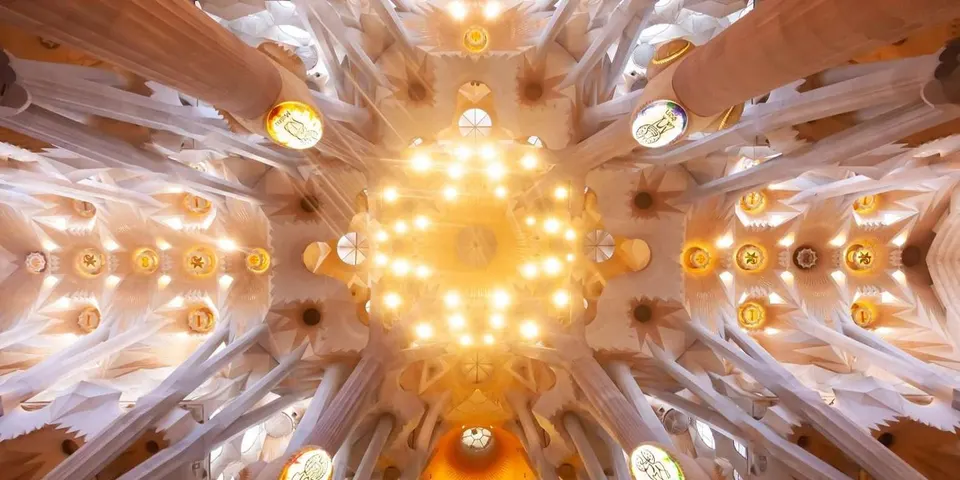
Yes. Searches for "Sagrada Família accessibility" often get tangled up with the tower rules, but the official FAQ is plain: "All of the Basilica is accessible, except for the towers."

Visitors with disabilities or reduced mobility use entrance B on Carrer de la Marina, and must show official proof of their disability there. From there you can see the nave, the branching columns, the stained glass and the main interior, plus the façades from the accessible visitor areas and the other parts of the regular route, subject to whatever temporary routing is in place on the day. Parts of the Basilica can close for events, so check your date before you book.

A normal Basilica ticket never involves a tower climb. People sometimes worry that the whole building is hard to visit once they read about the tower staircase. It isn't: the tower is an optional extra, and you can see everything Gaudí designed the interior for at ground level. Our guide to what you see inside the Basilica walks through it.

Does Sagrada Família lend wheelchairs?

Yes, subject to availability. You ask for one at entrance B on Carrer de la Marina. Because one isn't guaranteed to be free when you arrive, don't build the day around it: if a wheelchair is essential, bring your own or contact the Basilica before your visit.

Can you bring a guide dog?

Yes, into the Basilica. The official FAQ allows guide dogs in with visitors who need them. Guide dogs and assistance animals are not allowed on the tower route.

Other Experiences You Might Enjoy

Planning the rest of your Barcelona day

Sagrada Família is usually one stop in a longer day of Gaudí. Many visitors pair it with Casa Batlló (4.7/5 from more than 33,000 reviews), Park Güell (4.7/5 from more than 8,000 reviews for the guided fast-track tour) or La Pedrera (on a combined tour with Sagrada Família, 4.6/5 from more than 70 reviews). Access varies from one building to the next, so check each listing's accessibility notes before you book. More Gaudí tours, Barcelona sightseeing and Barcelona experiences are below.

Disability Tickets

Is admission free for visitors with a disability?

Yes. General Basilica admission is free for a visitor with a disability and one companion, with official proof required. In the official wording, disabled people and their companions only pay for the additional services.

Official ticketVisitor with a disabilityCompanion
Basilica€0€0
Guided tour€0€4
Basilica + tower€0€10
Guided tour + tower€0€14

These are the current official prices. Compare them with the €26 adult Basilica ticket on our Sagrada Família ticket prices page. The free rate is only on the official ticket: third-party tickets and guided tours charge their own prices, so book the visitor with a disability and their companion directly, and use a reseller only for the rest of the group if you need its flexibility.

A free ticket doesn't change the tower rules

The tower lines in the price list are €0 for a visitor with a disability, but the official ticket pages also say the tower is not accessible for people with reduced mobility or functional diversity. Qualifying for a disability ticket does not override the tower safety restrictions: you can be eligible for the price and still not be permitted on the route.

Hearing and Sight

Audioguide, sign-guides and tactile models

Many general visitor guides leave this out. The standard visit is more accessible for deaf and blind visitors than many historic monuments.

Is the audioguide accessible?

The official audioguide app is available in 19 languages, with sign-guides in Catalan Sign Language, Spanish Sign Language and International Sign. The standard version takes about 45 minutes and the express one about 25. Features can change, so check the official ticket information close to your visit.

Visitors with hearing impairments

The sign-guides make the Basilica visit workable without a spoken guide. If you are booking a guided tour instead, check the listing: guided tours run in spoken languages, and many use radio headsets.

Visitors with visual impairments

Since 2024 the Central Towers room has tactile models of the six central towers, including the Tower of Jesus Christ, and the museum's "Inspiration in Nature" hall has tactile pieces too. Guide dogs are welcome in the Basilica.

Is there an accessible alternative to going up the towers?

Yes. The audioguide in the official app includes a virtual tour of the towers with augmented reality, focused on the central towers. It isn't the same as standing up there, but if mobility rules out the tower route, it fills in much of the architecture you would otherwise miss.

The Towers

The one thing to know before buying a tower ticket

The lift only solves the ascent. Many ticket pages advertise "tower access" or "tower with elevator", which makes the visit sound easier than it is. After the upper tower route, you descend by the stairs.

So the physical question isn't "can I climb several hundred steps?" It's "can I comfortably walk down several hundred narrow spiral steps?" Those are different problems. Going downstairs for a long time can be harder than climbing on your knees, hips and ankles, on your balance, and on your confidence at height. If you're unsure about that, don't treat tower access as an automatic upgrade. The Basilica interior is the main event anyway.

How many stairs are there in the Sagrada Família towers?

There is no single reliable number. The Basilica explains the route, lift up and walk down, but publishes no step count on its tower ticket pages or visitor FAQ, and the figures repeated online vary by a couple of hundred steps. Part of the reason: the Nativity and Passion routes are not identical, route arrangements can change, some counts include intermediate stair sections and others don't, and many websites repeat older numbers without checking them. For planning, expect several hundred narrow steps down. Whatever the exact total, you are committing to a long spiral descent, not a short flight of museum stairs. Our towers guide covers the step question in more detail.

What the tower stairs are like

  • narrow stone stairs
  • spiral sections, often compared with a snail shell
  • limited passing space
  • stretches where you go single file
  • open gaps with views through the architecture
  • a long, continuous descent
  • a very different atmosphere from the bright, spacious nave

Some sections feel enclosed; others leave you very aware of the height. The spiral is beautiful, and it can feel unnerving if you don't like heights, tight spaces, spirals or looking down through a central opening. For a fuller description, see what the tower visit is like.

Heights and Tight Spaces

Is the staircase scary?

For most mobile visitors who are comfortable on stairs, probably not. But "scary" is personal. One visitor sees an amazing Gaudí staircase; another sees how far down it goes. If you have even moderate vertigo or claustrophobia, take it seriously and don't assume you'll be fine once you're up there. The official conditions exclude both from the tower route, a stronger warning than you'll find at most tourist attractions.

If you have vertigo

Officially, no tower. And it makes sense: you aren't standing on a secure terrace looking out over Barcelona, you're moving through high, narrow passages and spiral stairs built into the architecture. Even if a viewpoint doesn't bother you, the staircase might. Book Basilica-only entry; you still see the most important part of the monument.

If you are claustrophobic

Again, the official rule is clear: tower access isn't suitable for visitors with claustrophobia. The lift is only part of it. On the way down, walls can be close, the staircase is narrow, everyone moves one way, and turning back isn't as simple as leaving an ordinary room. This isn't the place to test your limits.

If you have bad knees

Knees aren't named in the official wording, but in practice they matter a lot: several hundred descending steps put repeated load through them. If you walk around Barcelona normally and can go down several floors comfortably, you'll probably manage. If going downstairs is when your knees hurt, the tower is a poor bet. You don't need to prove you can climb up; you need to be confident you can walk all the way down.

Tower Restrictions

Who cannot go up the Sagrada Família towers?

The official rules and conditions of sale say that, for safety reasons, wheelchairs, pushchairs, elderly people or people with reduced mobility, pregnant women, people with vertigo, anaemia, a tendency to dizziness, claustrophobia, heart problems, respiratory problems or other similar conditions, and guide dogs or assistance animals may not go up the towers. Children under 6 can't visit them, and under-16s need an adult. Basilica staff can refuse tower access to anyone who doesn't meet these requirements.

Wheelchair users

No. This is one of the clearest limits of the visit. The problem isn't getting up, it's the stair descent you can't avoid. Wheelchairs aren't permitted on the tower route.

Elderly visitors

The conditions name elderly people but publish no age cut-off, so age alone isn't a numerical rule. What matters is being able to complete the route safely, and staff can refuse entry. If you are older, fit and considering a tower, read the current conditions before booking; the lift doesn't make the route easy on its own.

Pregnant visitors

No. The purchase conditions say pregnant visitors may not enter the towers. The Basilica is a much easier visit: choose standard entry or a guided tour without tower access.

Heart, breathing and dizziness

Visitors with heart problems, respiratory problems, anaemia, dizziness or similar conditions are on the official list. If any of those apply to you, standard Basilica entry is the safer ticket.

Children and pushchairs

Children must be at least 6. Under 6: no tower access. Ages 6–15: only with an adult. 16 and over: no accompanying adult needed under this rule. This applies even if a younger child is confident on stairs. Pushchairs aren't allowed on the tower route, which makes sense once you see the stairs.

Canes and walking sticks

The towers are closed to visitors with reduced mobility and the route is narrow spiral stairs, so don't assume a mobility aid will be accepted. If you rely on a cane for safe walking, choose standard Basilica access, and check with Sagrada Família directly if you're unsure.

One GetYourGuide listing, the Sagrada Familia Tour with Optional Tower Access, also says visitors with any visual impairment can't take its tower option. If you're booking through a reseller, read its own conditions as well as the Basilica's. Our towers guide has more on who can go up.

Families

Is tower access a good idea with children?

That depends entirely on the child. A confident 10-year-old who enjoys heights may love it. A nervous 10-year-old who dislikes lifts, confined spaces, high viewpoints, spiral staircases or long descents may hate it, and this isn't an attraction where you want to find that out halfway down.

Three questions before you add a tower for the family

  1. Is every child at least 6?
  2. Are they comfortable with heights?
  3. Can they walk down several hundred steps on their own without being carried?

If any answer is no, skip the tower.

Can you carry a child down the stairs?

Don't plan on it. Even apart from the age rules, carrying a tired or frightened child down a narrow spiral staircase is exactly the situation the safety rules are there to avoid. If your child might need carrying after a long day of sightseeing, choose Basilica-only tickets.

Mixed Groups

What if only one person in your group wants the tower?

That's perfectly reasonable. Not everyone has to buy the same ticket: one adult can book Basilica + tower and another Basilica only. Just agree where you'll meet afterwards. Don't make the whole party do the tower because one person wants it.

Splitting tickets works well for couples with different comfort levels, grandparents travelling with family, parents with a child under 6, and groups where one person dislikes heights. Remember that tower tickets are timed and nominative, and you need official photo ID to enter the Basilica, so each ticket belongs to the person named on it.

If you want a guide for everyone and the tower for some, the Sagrada Familia Tour with Optional Tower Access runs 1.5–2 hours with an official guide and adds the tower only if you select it when booking (4.6/5 from more than 2,000 reviews, from £77). Book the tower option only for the people who can manage the stairs.

Families with a child under 6

A child under 6 can't go up. With two adults, one practical plan is to split: one adult does the tower, the other stays with the child, and then you carry on round the Basilica together. Check before you buy whether the timing and ticket conditions make swapping practical on your booking, and don't assume two adults can take turns on one tower ticket.

Bags and Lockers

Are bags allowed in the Sagrada Família towers?

No. Before going up, you leave backpacks, rucksacks and bags in the tower lockers provided for that purpose. It isn't only an inconvenience rule: on narrow stairs, loose bags take up space, catch on walls and rails, upset your balance and make an evacuation harder. Travel light.

Are there lockers?

Yes, with one big qualification. Sagrada Família doesn't run general luggage lockers. The lockers are only for bags while you visit the towers, and you collect your things as soon as you come back down.

Can you store a suitcase?

No. The official FAQ says there are no lockers for suitcases. If you're coming straight from a hotel checkout, the airport or a train, arrange luggage storage elsewhere first.

What can you take up?

Only essentials that staff allow: your phone, a small camera if current rules permit it, and essential personal items. Don't arrive with lots of loose gear expecting the tower to work like a normal viewpoint. Security staff have the final say.

Which Tower

Is the Nativity tower easier than the Passion tower?

A tower ticket normally covers one tower, Nativity or Passion, depending on the ticket and availability. They have different architecture and views, compared in Nativity or Passion: which tower is better?

You'll see claims online that one staircase is wider, shorter, less enclosed or easier than the other, and visitor accounts do suggest the routes differ. But both require the stair descent, and the official safety restrictions apply to tower visits in general. Choosing one tower over the other doesn't turn it into a lift-only visit.

Our advice: don't use one tower as an accessibility workaround. If several hundred spiral stairs are a serious concern, choose no tower at all instead of hunting for the marginally easier one.

Step by Step

How the tower visit works

A typical tower visit looks roughly like this.

  1. Enter Sagrada Família at the time on your ticket. Tower tickets are timed and nominative, so bring official photo ID.
  2. Visit the Basilica. Depending on the current routing and your tower time, you explore the interior before or after the tower.
  3. Go to the tower access point shown on your ticket.
  4. Store your bag in the temporary lockers.
  5. Take the lift up. This is the easy part.
  6. Explore the upper tower route, with views through and around the architecture and details you can't see from the street.
  7. Walk down. This is the physically demanding part, and the reason for the restrictions.
  8. Collect your belongings from the lockers straight away.

How long does the tower experience take?

The official Sagrada Família + tower ticket gives an approximate visit length of 1 hour 30 minutes. That covers the whole ticket, not 90 minutes inside the tower; the tower is only part of it. Allow extra time if you like to photograph architecture, read the exhibitions, linger in the nave or look at both façades from outside. Sagrada Família isn't a monument to squeeze into a tight schedule; see how long you need at Sagrada Família.

How Hard Is It

How physically difficult is the descent?

For a healthy person used to walking, we'd call it moderate, not strenuous. You aren't climbing against gravity, but the number of steps, the tight spiral and the repeated downward movement make it harder than an ordinary viewpoint with a lift.

Easy for

  • active adults
  • older children comfortable on stairs
  • regular city walkers

Potentially difficult for

  • knee problems
  • poor balance
  • low confidence on spiral stairs
  • tiredness
  • fear of heights

Not permitted under the official rules

  • reduced mobility
  • wheelchair users
  • pregnancy
  • vertigo
  • claustrophobia
  • certain health conditions

Can you stop and rest on the stairs?

Don't count on regular resting places. The route is narrow and visitors keep moving; it isn't like a cathedral dome with broad landings where you can sit down. If you already know you'd need a break every few flights, the tower isn't a good fit.

Can you turn around once you've started?

The route is designed to move visitors one way through the tower. Don't book on the assumption that you can change your mind halfway and go back against the flow. If you're unsure, speak to staff before you enter the tower route.

Footwear

What shoes should you wear for the towers?

Wear something you can comfortably walk down hundreds of stairs in: a secure fit, decent grip, a flat or low sole, and comfort first. Don't choose footwear for the photos; the staircase is one place where practical shoes win. The Basilica's own dress code applies on top.

Are high heels a good idea?

Not for a tower visit. Even if staff at the entrance don't object to your shoes, hundreds of narrow descending steps are no place for heels. Choose stable shoes.

Is the staircase slippery?

Stone stairs get harder when they are worn smooth, when your soles have poor grip, when you're tired, or when you're watching the view instead of your feet. Go down slowly and use the handholds and rails where they exist, without rushing behind the person in front.

Closures and Lifts

Do the Sagrada Família tower lifts ever close?

Yes. The official conditions close the towers for safety in adverse weather, and also for breakdowns, maintenance or force majeure. Wind is especially relevant on tall, exposed architecture. When the tower can't open, the Basilica visit usually goes ahead as normal.

What happens if the tower closes because of weather?

The detailed rules and conditions of sale refund the tower part of the ticket, not the Basilica admission, since you still visit the main monument. Some individual official ticket pages word this differently and say there is no reimbursement if the towers close, so check the terms attached to your own booking. Either way, treat the tower as an upgrade and don't plan your whole visit around it.

Can you get a refund if the stairs look too difficult?

Don't assume so. Book a tower only if you're comfortable with the stated conditions. The official terms say that if staff refuse tower access because you don't meet the safety requirements, you can claim the tower amount, while Basilica admission and other services stay payable. That isn't the same as a "changed my mind at the staircase" refund.

What if the lift breaks?

A technical fault can close the tower; the official rules allow closures for breakdowns and maintenance. You won't be asked to climb the whole tower instead. If the lift can't run safely, tower access is suspended.

What if you dislike lifts?

There is no stair alternative for the ascent on the normal visitor route: you go up by lift. Someone uncomfortable with both lifts and tight stairs probably shouldn't book the tower.

The Central Towers

Does the lift go all the way to the top?

The visitor lift takes you up into a Nativity or Passion tower. Don't imagine stepping out on the summit of one of the new central towers, which stand between 135 and 172.5 metres tall, the Tower of Jesus Christ being the tallest.

The standard public tower ticket in 2026 still means visiting one of the façade towers. The central towers are a separate part of the building, and the exterior of the Tower of Jesus Christ was completed in February 2026 while work on its interior continued.

Can you visit the Tower of Jesus Christ?

Not as the standard public tower visit at present. "The Tower of Jesus Christ has a lift" is not the same as "my tower ticket takes me to the top of the Tower of Jesus Christ". It doesn't.

Skipping the Towers

Are the towers essential to visiting Sagrada Família?

No, and this is the most reassuring thing to tell anyone who can't manage the stairs. You aren't missing the best part of Sagrada Família by skipping the towers. The towers are an optional extra; the reasons to visit are downstairs.

What every Basilica ticket includes

  • the nave and the branching forest of columns
  • the stained glass
  • the vaults, altar and apse
  • the Nativity and Passion façades
  • Gaudí's geometry and sculpture
  • the museum and exhibition material
  • the sheer scale of the central space

If accessibility rules out the tower, you aren't getting half a visit. You miss a viewpoint and some close-up architecture, not the heart of the Basilica. The moment most visitors remember is at ground level: walking into Gaudí's luminous forest of stone columns and coloured light.

Are the towers worth it if you're physically able?

They can be. From a tower you get unusual views over Barcelona, Gaudí's spires, pinnacles and mosaics close to eye level, glimpses between different parts of the Basilica, and the experience of moving through the bell towers. But this isn't a conventional rooftop observation deck: you're mostly inside the architecture, looking through and around it. If you mainly want a huge panorama of Barcelona, there are easier viewpoints elsewhere. If being inside Sagrada Família's architecture excites you, the tower ticket makes much more sense. More in are the Sagrada Família towers worth it?

Should I Book a Tower?

Tower ticket or Basilica only

This turns the official restrictions into a booking decision. Several items on the second list are rules, not suggestions.

A tower ticket is probably a good fit if…

  • you walk comfortably and manage stairs without help
  • you're fine with heights
  • narrow spaces don't bother you
  • everyone in your party is 6 or over
  • you want close-up architecture and elevated city views
  • you have enough time not to rush

Stick with Basilica-only if…

  • you use a wheelchair or a mobility aid, or have reduced mobility
  • stairs cause pain, or going down them hurts your knees
  • your balance isn't good
  • you have vertigo or claustrophobia
  • you're pregnant
  • you have relevant heart or respiratory problems
  • you're travelling with a child under 6
  • anyone in your party is uneasy about a long spiral descent
Basilica onlyBasilica + tower
Main interiorYesYes
Stained glassYesYes
Nativity and Passion façadesYesYes
Lift requiredNoYes
Long stair descentNoYes
Suitable for wheelchairsYesNo
Under-6sYesNo tower
Vertigo-friendlyGenerally yesNo
Close-up tower architectureNoYes
Elevated viewsNoYes

Unsure which ticket type fits the rest of your plans? Our best way to visit Sagrada Família compares tickets, tours and towers, and the tower tickets guide covers booking tower access.

Checklist

Accessibility checklist before booking

Run through this before you pay for a tower. It can save you buying the wrong ticket.

Book Basilica-only if any of these apply

  • wheelchair user
  • reduced mobility
  • pregnancy
  • significant vertigo
  • claustrophobia
  • frequent dizziness
  • heart problems
  • respiratory problems
  • difficulty going down stairs
  • child under 6

A tower ticket suits you better if you

  • comfortably walk several kilometres
  • manage stairs without help
  • have no problem with heights
  • don't mind narrow, enclosed spaces
  • can walk down several hundred steps without stopping

Visiting with a disability? Bring official proof for entrance B, and book the free ticket on the official website.

FAQ

Sagrada Família stairs and accessibility: frequently asked questions

Does Sagrada Familia have elevators?

Yes. Tower visitors take a lift up. The main Basilica is accessible for visitors with reduced mobility, but the tower route is not suitable for them because you walk down.

Can you take the elevator both up and down?

No. The standard tower route is lift up, stairs down, so don't buy a tower ticket expecting to ride the lift back to the ground.

How many steps are in the Sagrada Familia towers?

The Basilica publishes no official total, and the figures quoted online vary widely. Plan for several hundred narrow steps down a spiral staircase.

Do you have to climb stairs to visit Sagrada Familia?

Not for the main Basilica. Stairs only become an issue if you add tower access.

Is Sagrada Familia wheelchair accessible?

The Basilica is. The official FAQ says all of it is accessible except the towers. Wheelchair users and visitors with reduced mobility go in through entrance B on Carrer de la Marina.

Can wheelchair users go up the tower by lift?

No. A lift takes tower visitors up, but the route back down is on foot and wheelchairs are not permitted on it.

Can pregnant women visit the towers?

No. Pregnancy is listed in the official tower safety restrictions. The Basilica itself is fine to visit.

Can people with vertigo visit the tower?

The official rules say no. Vertigo is one of the conditions listed as incompatible with tower access.

Can people with claustrophobia visit?

They can visit the Basilica, but the official conditions exclude visitors with claustrophobia from the towers.

Can children visit the towers?

Yes, from the age of 6. Children aged 6 to 15 must be accompanied by an adult.

Can babies visit the towers?

No. Children under 6 are not allowed up, and pushchairs are not permitted on the tower route.

Are bags allowed?

Not on the tower route. Backpacks and bags go in the temporary tower lockers before you go up.

Is there luggage storage?

Not for suitcases. The lockers are only for bags during a tower visit, and you collect your things as soon as you come down.

Can you skip the stairs?

Not on the normal tower route. If you can't safely manage the descent, book the Basilica without tower access.

Do the towers close when it rains?

They can. The official conditions close the towers in adverse weather, and also for breakdowns, maintenance or force majeure.

What happens if my tower is closed?

Your Basilica visit goes ahead. The official conditions of sale refund the tower part of the ticket, not the Basilica admission, although some individual ticket pages word this differently, so check the terms on your own booking.

Where is the accessible entrance at Sagrada Familia?

Entrance B, on Carrer de la Marina. Visitors with disabilities or reduced mobility go in there and show official proof of disability, and that is also where you ask for a wheelchair.

Is Sagrada Familia free for visitors with a disability?

Yes. The official price list gives a visitor with a disability and one companion free Basilica entry. The visitor with a disability also pays nothing for the guided tour or tower options, while the companion pays €4, €10 or €14 for those extras. Official proof is required.

Not sure whether to add tower access?

If everyone in your group is comfortable with several hundred stairs, the tower can be a fascinating upgrade, especially if you want close-up architecture more than another city viewpoint. If mobility, knees, heights or confined spaces are a concern, choose standard entry or a guided Basilica tour instead. The right ticket is the one that suits everyone in your group, not the most expensive one.