Construction

When will Sagrada Família be finished? Construction timeline and 2026 update

Sagrada Família isn't finished yet. It reached its final height of 172.5 metres on 20 February 2026, when the last section of the cross went onto the Tower of Jesus Christ. That completed the outside of the tallest tower and of all six central towers, but not the whole church. Work continues on the Glory façade and its towers, the Chapel of the Assumption and the inside of the Tower of Jesus Christ, and the Basilica lists the date for completing the whole building as "to be determined".

Last checked November 2026

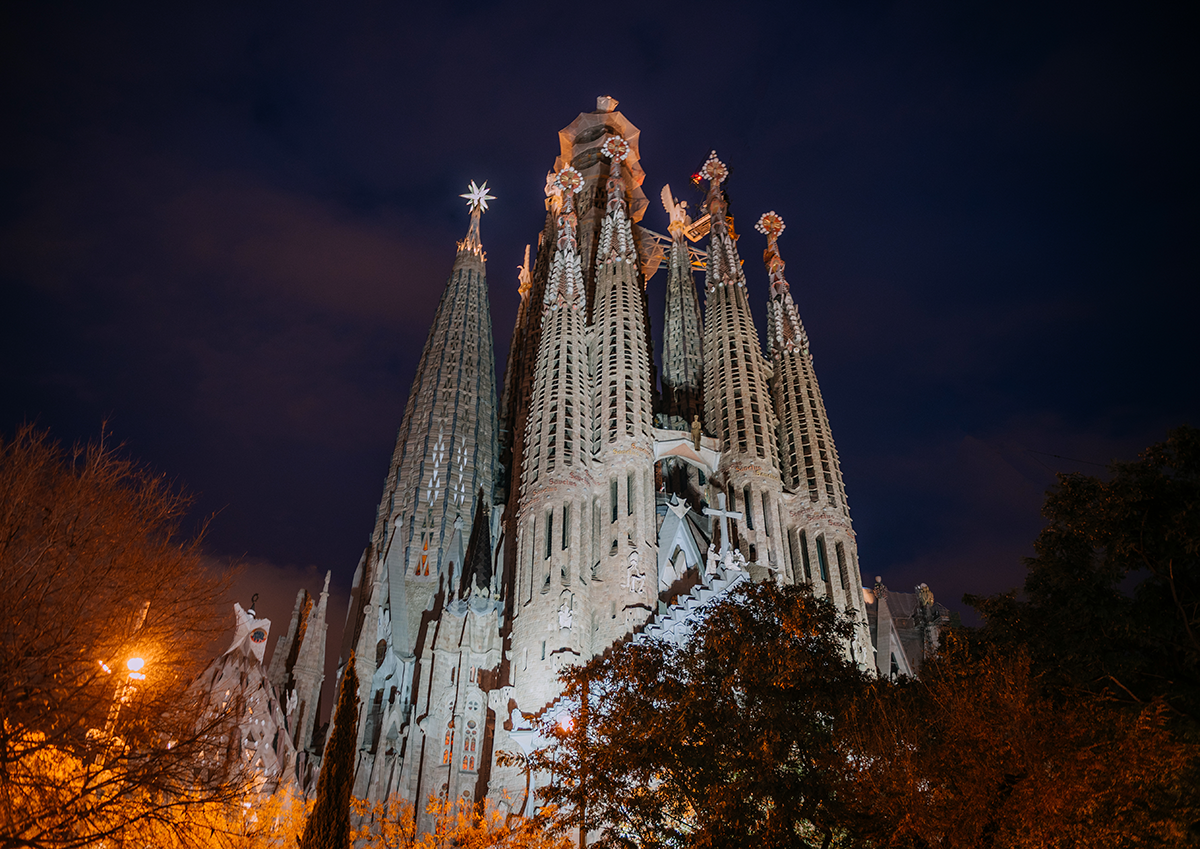
Sagrada Familia lit up at night, with its towers rising above Barcelona

Begun 1882 · full height reached 20 Feb 2026

172.5 m, still under construction final completion date: to be determined

If you arrive in Barcelona expecting a Sagrada Família free of cranes because you read it would be "completed in 2026", expect a surprise. 2026 was a huge milestone, but it wasn't the end of construction. What happened was more specific, and arguably more interesting.

On 20 February 2026, builders lifted the upper arm of the enormous cross onto the Tower of Jesus Christ, a piece about 4.9 metres tall. For the first time since work began in 1882, Gaudí's basilica stood at its full planned height. The central towers that define the skyline are now in place.

Construction has shifted, not stopped. The giant crane that built the Tower of Jesus Christ has been lowered and will mainly work on the Glory façade, where new towers will rise to 120 metres. Inside the central tower, work continues on the interior and a lift, and elsewhere builders are working on the Chapel of the Assumption and the adjoining cloister.

The 2026 milestone in one line

Sagrada Família is now as tall as it will ever be, but not yet as complete as it will eventually be. It has reached its full height, not its final form.

See the Work in Progress

Seeing the building site with a guide

From inside the nave it is hard to tell which parts are 140 years old and which went up last year. On the Skip-the-Line Entry Ticket & Tour, an official guide spends about 1.5 hours on Gaudí's construction techniques, the work still going on and the current predicted completion date (4.8/5 from over 15,000 reviews on GetYourGuide, from £60). Tours start strictly on time and the security check can take up to 25 minutes in high season, so arrive early and check your date below.

Pоwered by GetYourGuide

Construction Status

What is finished and what isn't

Construction status, last checked November 2026. The quickest way to see where the project stands:

Part of the BasilicaStatus in 2026
Nave and interiorComplete for normal visits
Nativity façadeBuilt; restoration under way
Passion façadeMain architecture complete
Tower of the Virgin MaryComplete
Four Evangelist towersComplete
Tower of Jesus Christ, outsideComplete
Tower of Jesus Christ, insideWork continuing
Glory façadeUnder construction
Glory façade towersUnder construction
Chapel of the AssumptionUnder construction
Whole BasilicaNot yet complete; no completion year announced

Completion Date

When will Sagrada Família be finished?

There is currently no firm official date for completing Sagrada Família. The Basilica's own information booklet divides the project into phases and labels the last one: "Under construction, date to be determined: completion of the Basilica."

That is more useful than the many headlines that said Sagrada Família would be "finished in 2026". The 2026 target referred to one of the project's biggest architectural milestones, completing the six central towers and above all the Tower of Jesus Christ. That milestone has now been reached. Completing absolutely everything is another matter.

In September 2025 the project's chairman, Esteve Camps, told Reuters that "in normal circumstances, without obstacles, it is likely that in 10 years we could be finished", which points to the mid-2030s. He added, "We cannot say whether it will be 10, 11 or 12 years." Treat it as a projection, not a deadline.

QuestionCurrent answer
Is Sagrada Família finished?No
Has it reached its final height?Yes, 172.5 m in February 2026
Are all six central towers finished outside?Yes
Is the Tower of Jesus Christ finished inside?No
Is the Glory façade finished?No
Are cranes still there?Yes
Official completion dateTo be determined
Longer-term estimate reported publiclyAround the mid-2030s

The 2026 Target

Why did everyone say Sagrada Família would be completed in 2026?

Because 2026 was meant to be the symbolic finish line: exactly 100 years since Antoni Gaudí died in 1926, an obvious date for completing his most famous work. For years the plan was to have the main structure done for the centenary.

Then COVID-19 intervened. Visitor numbers collapsed in 2020, construction was suspended for a time, and the ticket revenue that pays for the building disappeared, so the timetable slipped. By the time 2026 arrived, the project had recovered enough to finish its most important remaining vertical element, the Tower of Jesus Christ, but not the entire basilica.

Other Experiences You Might Enjoy

Finished Gaudí buildings to see on the same trip

Sagrada Família is the one Gaudí building still under construction; his other Barcelona works have long been complete and are open to visitors. Park Güell (4.7/5 from over 8,000 reviews for the guided fast-track tour) and Casa Batlló (4.7/5 from over 33,000 reviews) are the usual pairings, and Gaudí tours, Barcelona Modernisme walks and other Barcelona sightseeing tours are below.

20 February 2026

What exactly was completed in 2026?

The big moment came on 20 February 2026, when workers installed the upper arm of the cross on top of the Tower of Jesus Christ.

That one lift achieved three things at once:

  1. it completed the outside of the Tower of Jesus Christ
  2. it completed the group of six central towers
  3. it brought the whole basilica to its maximum height of 172.5 metres

The cross itself is enormous: 17 metres tall, about the height of a five-storey building, and 13.5 metres across. Its surface uses white glazed ceramic and glass, so it reflects light by day and can be lit at night.

10 June 2026: the blessing

On 10 June 2026, exactly 100 years after Gaudí's death, Pope Leo XIV blessed the completed tower during a solemn Mass, and that evening the Tower of Jesus Christ was lit for the first time. For Barcelona it was the symbolic moment many people had waited decades for. But construction didn't end the next morning.

Still Being Built

What is still unfinished at Sagrada Família?

As of autumn 2026, several significant projects remain.

1. The Glory façade

This is the big one. The Glory façade, on the Carrer de Mallorca side, will become the basilica's main monumental entrance, and Gaudí conceived it as the largest and most important of the three façades. It represents humanity's journey towards God, with themes including death, judgement, glory, virtue and sin, and the path to salvation. If you've seen the densely decorated Nativity façade and the severe Passion façade, the Glory façade completes the story.

It is still a major construction project. The central crane is now mainly being used to build the Glory façade towers, planned to reach 120 metres, and in its September 2026 update the Basilica said work was concentrating on the Glory façade after the central tower, with head architect Jordi Faulí marking the completed Jesus Christ tower as one of the year's biggest milestones. So if you wonder what the cranes are doing now, this is largely the answer.

2. The inside of the Tower of Jesus Christ

This distinction is easy to miss: the outside is finished; the inside isn't. The Basilica's September 2026 update says work is continuing inside the tower, with the next phases completing its interior spaces, removing the internal scaffolding and installing a lift. The interior is designed around the symbolism of the heavens and will include the Agnus Dei, the Lamb of God, inside the cross.

The Basilica says the interior will be fully visible in about a year, once the scaffolding comes down, and its account of the cross mentions work inside the structure continuing in 2027 and 2028. You can already see the tower dominating Barcelona from outside, but its interior is still being finished.

3. The Chapel of the Assumption

Building also continues on the Chapel of the Assumption, behind the apse on the Carrer de Provença side, one of the lesser-known parts of Gaudí's plan. It is a square-plan chapel dedicated to the Virgin Mary, crowned by a 30-metre blue dome that stands for Mary's mantle, held up by four angels. Work in 2026 included sculpture for the chapel's exterior, the stone vault of the tribune and decorative elements for the adjoining cloister. It won't make headlines like the central tower, but it shows why "Sagrada Família is finished" is still premature.

4. Cloisters and connecting parts

Gaudí designed cloisters running round much of the basilica's perimeter. They weren't meant as mere corridors: they separate the sacred interior from the noise of the city. Some sections have stood for years; others are part of the remaining work around the Chapel of the Assumption and the Glory façade.

5. Sculpture and decoration

Finishing the structure doesn't mean finishing the decoration. Sagrada Família combines architecture, sculpture, inscriptions, ceramics, stained glass and religious imagery on a scale that makes decoration a construction programme of its own, and the Glory façade in particular still needs a great deal of artistic work.

Keep that in mind when you read future "completion" announcements. There may be several real finish dates, and they need not fall in the same year:

  • structural completion
  • architectural completion
  • completion of the façades
  • completion of the decoration
  • completion of the landscaping and access

And restoration on the oldest parts

There is a curious side effect of taking 144 years to build a church: some of its oldest sections need restoring before the newest are finished. Conservation of the Nativity façade, including its historic stonework and towers, is continuing, and in September 2026 the Basilica said restoration would soon begin on the Simon bell tower. Sagrada Família now has new construction, finishing work, artistic decoration and historic conservation going on at the same time, which few major monuments can say.

1882 to 2026

The Sagrada Família construction timeline

The building has been a church and a construction site at the same time for most of its existence. The dates below follow the Basilica's own chronology.

DateWhat happened
19 March 1882The cornerstone is laid. The first architect, Francisco de Paula del Villar, plans a fairly conventional neo-Gothic church; Gaudí isn't in charge yet.
1883Antoni Gaudí takes over and gradually turns Villar's church into something far more ambitious: 18 towers, three monumental façades, five naves, transepts, an apse, cloisters, sacristies, chapels and the huge central Tower of Jesus Christ.
1885The Chapel of Saint Joseph in the crypt opens, and worship begins while building continues.
1891Work begins on the Nativity façade, the part most directly tied to Gaudí's lifetime.
1914Gaudí stops taking other commissions and spends his last 12 years only on Sagrada Família, knowing he will never see it finished.
1925The bell tower of Saint Barnabas on the Nativity façade is completed, the only tower Gaudí sees finished.
10 June 1926Gaudí dies, days after being struck by a tram. His collaborators carry on.
1936In the Spanish Civil War his workshop is attacked: drawings are burned, photographs destroyed and plaster models smashed. Because Gaudí relied heavily on three-dimensional models more than on detailed drawings, the loss is one of the biggest problems later architects face.
1939 onwardsArchitects and craftspeople rebuild the surviving model fragments and interpret Gaudí's intentions, which is what lets construction continue.
1954Work begins on the stark, monumental Passion façade.
1976The four Apostle towers of the Passion façade are completed, and the silhouette starts to look like the one visitors recognise.
Late 1970s to 2010The main body of the church takes shape: foundations, columns, façades, nave vaults, cloisters and the Passion façade sculpture.
1986Major work begins on the nave. The nave, transept, crossing and apse go up from the late 1980s onwards, with computer modelling increasingly important.
2005The Nativity façade and crypt become part of UNESCO's Works of Antoni Gaudí World Heritage Site. UNESCO does not list the whole modern basilica.
7 November 2010Pope Benedict XVI consecrates the church and declares it a minor basilica. The interior becomes a working place of worship, and the modern visitor experience really begins.
2016The western sacristy and the cloister of Our Lady of Dolours are completed, and construction begins on the six central towers. Work on the Passion façade pediment continues through the 2010s.
March 2020COVID-19 halts construction, and with Barcelona tourism shut down the visitor income that funds the work collapses. Work resumes later in 2020, but the old 2026 goal becomes much harder.
29 November 2021The star crowning the Tower of the Virgin Mary is installed; the tower rises 138 metres, and on 8 December the star is lit for the first time.
2022The towers of the Evangelists Mark and Luke are completed, each topped by its traditional biblical symbol.
12 November 2023The four Evangelist towers, about 135 metres tall, are inaugurated together. Five of the six central towers are now complete; only Jesus remains.
2024 to 2025The Tower of Jesus Christ rises quickly. A huge crane installed in May 2024 has the top of its jib about 203 metres above the ground, high enough to place pieces above the tower.
Late 2025 to early 2026The cross is assembled piece by piece from prefabricated parts, partly concrete and stainless steel; the four horizontal arms go up before the final upper section.
20 February 2026The upper arm of the cross is lifted into place. The basilica reaches 172.5 metres for the first time, and the outside of the Tower of Jesus Christ is complete.
10 June 2026On the centenary of Gaudí's death, Pope Leo XIV blesses the tower, which is then lit for the first time.
July 2026The main crane is lowered to 174 metres, not removed, and reassigned mainly to the Glory façade towers.
September 2026The Basilica's construction update names the main projects: the inside of the Tower of Jesus Christ and its lift, the Glory façade, the Chapel of the Assumption, and restoration of the Nativity façade.

The Last Six Towers

The final group of six central towers

The phase that changed the skyline began in earnest in the 2010s. Gaudí's complete plan calls for 18 towers, and the central six are Jesus Christ, the Virgin Mary, Matthew, Mark, Luke and John.

TowersRepresent
12Apostles
4Evangelists
1Virgin Mary
1Jesus Christ
18 total

Why the central towers went up so fast

Unlike most earlier parts of Sagrada Família, the central towers were built with extensive prefabrication. Large stone-and-steel panels were assembled before being lifted into place, which sped up construction dramatically.

172.5 Metres

Why is the Tower of Jesus Christ 172.5 metres tall?

Gaudí deliberately kept Sagrada Família lower than Montjuïc, the hill overlooking Barcelona. The usual explanation is that human work shouldn't surpass God's natural creation.

Whatever you make of the symbolism, the practical result is striking: the Tower of Jesus Christ dominates the basilica without chasing an engineering record. Our Sagrada Família architecture explained guide covers what each tower stands for.

July and September 2026

The crane comes down, a little, and work enters the next phase

July 2026: lowered, not removed

A wonderfully clear sign that construction isn't over came the month after the blessing. The main crane was not removed. Having finished its work on the 172.5-metre tower, it no longer needed to reach so high, so it was cut down to 174 metres, and its new job is mainly the Glory façade towers, planned to reach 120 metres. That is perhaps the simplest picture of where the project stands: the highest work is finished; lower construction continues.

September 2026: the next phase

In its September construction update, the Basilica named the main active projects:

  • finishing the inside of the Tower of Jesus Christ
  • installing its lift
  • advancing the Glory façade
  • continuing the Chapel of the Assumption
  • restoring the historic Nativity façade

That is where the project stands today.

The Glory Approach

What about the controversial Glory façade staircase?

This is one of the hardest parts of predicting a final completion date. Gaudí's plans for the Glory façade imagined a monumental approach from the Carrer de Mallorca side. The problem is that modern Barcelona grew up around the unfinished basilica.

Buildings now stand on land that could conflict with versions of the planned grand approach and staircase. That has created a long-running dispute involving:

  • the Basilica
  • Barcelona's city authorities
  • property owners
  • residents
  • businesses

Why one year for "everything" is unlikely

The staircase question is separate from whether the Glory façade itself can keep being built. It is also why you should be wary of any headline giving one definitive year when everything will be complete: the basilica and its final urban setting are related, but they are not the same project.

The Mid-2030s?

So is 2035 the new completion date?

Treat 2035 as a rough projection, not a confirmed deadline. In September 2025, Reuters reported the chairman's view that the project could be finished in about ten years, which points to the mid-2030s, and he said himself it could be 10, 11 or 12. The Basilica's own documentation is more cautious and still says "date to be determined".

For a visitor, the distinction is simple: don't postpone a visit while you wait for Sagrada Família to be completely finished. There is no guaranteed finish date, and today's basilica is already overwhelmingly complete as a place to visit.

Visit Now or Wait?

Is it worth waiting until Sagrada Família is finished?

Probably not. If Barcelona is already in your plans, there is very little reason to delay your visit just because construction continues.

Most of what makes Sagrada Família extraordinary is already there:

  • the nave
  • the stained glass
  • the Nativity façade
  • the Passion façade
  • the apse
  • the towers open to visitors
  • the museum and exhibitions
  • now, the complete outline of the six central towers

You'll see construction, but you aren't touring a half-built shell. Far from it: the main visit is already mature.

You don't need to wait for the full experience

The nave, the historic façades and the visitor towers are already open. If this is your first visit, compare standard entry, guided tours and tickets with a tower before you choose, because what you get varies a lot with what you book. Our guide to the best way to visit Sagrada Família compares tickets, tours and towers.

During Your Visit

Will construction spoil my visit?

For most visitors, no. You may see cranes, hoarding, temporary barriers, construction equipment or work on particular sections, but the main interior is spectacular and fully usable.

It can even be interesting to visit while the work goes on, because you see a stage of the building future visitors won't. Someone visiting in 2019 never saw the finished Virgin Mary tower. Someone visiting in 2022 didn't see all four Evangelists complete. Someone visiting in 2024 didn't see the finished Tower of Jesus Christ. And visitors today still get to watch the Glory façade take shape.

Is there construction noise inside?

Possibly, depending on what work is happening that day. Construction is organised around visitor access, religious services, safety and the running of the basilica. Don't expect complete silence, but don't imagine walking through an ordinary building site either. The church is so large that much of the work goes on without dominating the interior.

The Towers

Which towers are finished, and can you climb the newest one?

Are the Nativity and Passion towers finished?

Yes. The four Nativity towers were completed in the early decades of the project, and the four Passion towers in 1976. Visitor access can still be affected by maintenance, weather and operations, but their construction is complete. Our Nativity or Passion tower guide helps you choose between them.

Are all 18 towers finished?

Not yet, so this needs a careful answer. The famous central group, Jesus Christ, the Virgin Mary and the four Evangelists, is complete on the outside, the Jesus tower last of all in February 2026. Construction continues on the towers of the unfinished Glory façade, so a headline saying "all the Sagrada Família towers are finished" would still be misleading.

Can visitors go up the Tower of Jesus Christ?

Not as a standard tower visit yet. The outside may look finished from the street, but the interior was still being completed in late 2026, and the Basilica says the work includes a lift. When you book a tower ticket, check which tower it names; don't assume the newest one is included. Our towers guide covers the current options.

Why So Long?

Why has Sagrada Família taken so long to build?

The glib answer is "because it's complicated". The real one combines several things.

It was funded differently

Sagrada Família has relied on donations, not upfront government money, and today visitor revenue does most of the work, so the pace of construction has always depended partly on income.

Gaudí died before finishing it

He died in 1926 with only a fairly small part of the final basilica built, and later architects inherited an enormous unfinished concept.

Plans and models were destroyed

The 1936 attack damaged the workshop and destroyed key source material, and the surviving plaster models had to be painstakingly reconstructed. The war didn't just slow construction; it destroyed design information.

The architecture is extraordinarily complex

Its geometry involves hyperboloids, helicoids, inclined columns, branching supports, ruled surfaces, complex vaults and irregular sculptural forms, many of them very hard to design, make and assemble.

Technology had to catch up with Gaudí

Computer-aided design transformed the project, along with digital scanning, CNC stone cutting, modern structural engineering, prefabrication, high-strength materials and enormous cranes. Together they let recent construction move much faster.

COVID hit the money

The pandemic stopped work for a time and wiped out tourism revenue, which was enough to derail the much-publicised target of finishing everything by 2026.

Old Ideas, New Tools

How computers helped finish Gaudí's design

Gaudí worked out complex geometry decades before computers existed. He solved extraordinarily complicated structural problems physically, not digitally.

His tools included:

  • hanging-chain models and weighted strings
  • mirrors
  • plaster models
  • ruled surfaces, hyperboloids and helicoids
  • branching structural systems

Later architects translated those shapes into computer models, and modern techniques made it possible to:

  • calculate difficult geometry accurately
  • reconstruct damaged models digitally
  • cut stone with computer-controlled machines
  • prefabricate huge structural components
  • assemble major sections away from the basilica

Paradoxically, 21st-century technology became one of the tools needed to build an idea conceived in the 19th and early 20th centuries.

Built Off Site

How is modern Sagrada Família actually built?

The latest towers went up very differently from the picture of medieval masons slowly stacking blocks. Many of their components were prefabricated off site.

For the central towers, stone, concrete and stainless-steel elements were assembled into large modules, then taken to the basilica and lifted into place. The Basilica's workshop in Gaià, in Catalonia, produced all the modules for the six central towers, and in July 2026 the Basilica agreed with the town to keep the workshop there.

That explains the surprisingly fast recent growth. For decades progress seemed almost glacial; then large pieces of the skyline appeared in a short time.

The Finished Basilica

What will Sagrada Família look like when it's finished?

The completed church is designed around three façades and an 18-tower hierarchy.

FaçadeStory
NativityThe birth and early life of Christ
PassionSuffering and crucifixion
GloryHumanity's journey towards God and eternal glory

The 18-tower hierarchy

The towers rise in height and symbolic importance towards the centre. The Apostle towers form the lower outer group, the Evangelists rise above them, the Virgin Mary tower higher still, and Jesus Christ takes the central, highest point. With the central group now standing, that hierarchy is much easier to read from outside.

Old and New Stone

Why are some parts of Sagrada Família different colours?

Because they were built decades, sometimes more than a century, apart. Old stone has been exposed to rain, pollution, sunlight, oxidation and Barcelona's urban air; newer stone hasn't.

The result is a visible patchwork, and it isn't a defect: the changing stone is a construction timeline written across the building. You can often tell roughly where one generation stopped and the next began.

Gaudí's Plan Today

Has the design changed since Gaudí died?

Yes, in detail, but the project still follows Gaudí's overall architectural programme. Gaudí didn't leave modern construction drawings for every component of the finished basilica.

Later architects have had to interpret:

  • surviving models
  • photographs
  • plans
  • published material
  • testimony from his collaborators
  • Gaudí's geometric systems

A multi-generational interpretation

New artists have also added work in their own styles, the Passion façade sculptures by Josep Maria Subirachs being the most obvious example. So the finished church won't literally be a building frozen in 1926. It is a multi-generational interpretation of Gaudí's design, and our Sagrada Família history traces how each generation added its part.

A Building That Keeps Going

Will Sagrada Família ever really be "finished"?

Architecturally, yes. But there is a lovely paradox: by the time the last new sections are complete, the oldest will already need constant conservation. That has started: the Nativity façade is being restored while the Glory façade is still being built.

Sagrada Família may one day stop being an active construction project, but it will never stop being a conservation project. In that sense it is becoming like every other great historic cathedral, only considerably later.

FAQ

Sagrada Família construction: frequently asked questions

When did construction of Sagrada Família start?

Construction began on 19 March 1882, so as of 2026 the project has been under way for 144 years.

Was Sagrada Família supposed to be finished in 2026?

2026 was a long-standing target for major completion because it marked the centenary of Antoni Gaudí's death. COVID-19 disrupted that schedule. The exterior of the most important remaining central tower was completed in 2026, but not the whole basilica.

What was completed in 2026?

The exterior of the Tower of Jesus Christ. Installing the upper arm of its cross on 20 February 2026 brought Sagrada Família to its maximum height of 172.5 metres and completed the outside of the six central towers.

What is still being built?

The main remaining work is the Glory façade and its towers, the inside of the Tower of Jesus Christ and its lift, the Chapel of the Assumption, the adjoining cloister, and sculpture and decoration. Restoration is also under way on older parts, including the Nativity façade.

What is the new Sagrada Família completion date?

There is no confirmed official date. The Basilica's own information booklet lists the completion of the Basilica as under construction, date to be determined. The project's chairman said in 2025 that it could be finished in about ten years, but would not commit to an exact year.

Will the Glory façade be finished last?

It is the largest remaining piece of exterior construction and is expected to be one of the last defining stages of the basilica.

Is Sagrada Família still worth visiting during construction?

Yes. The nave, the Nativity and Passion façades and the main visitor areas are complete, and the finished central towers now give the church most of its intended silhouette. The ongoing work affects the surroundings more than the experience of standing inside the nave.

Visit now, or wait until it's finished?

If you're planning a Barcelona trip, visit now. Waiting for the day the last worker leaves won't improve the experience enough to justify it, and there is an advantage to coming during the final construction decades: look at the cranes around the Glory façade and you're seeing something temporary. Future generations will know Sagrada Família only as a finished monument. You can still see it becoming one.