Architecture

Sagrada Família architecture explained: Gaudí, façades and symbolism

Sagrada Família makes much more sense once you know how to read it. The columns inside branch like trees because the branches carry the weight of the roof. The Nativity façade faces the rising sun and celebrates birth, while the Passion façade faces west, towards sunset, and shows Christ's death. Above them, 18 planned towers form a hierarchy that ends in the 172.5-metre Tower of Jesus Christ. Even the stained glass follows the sun: cool blues and greens on the morning side, reds and oranges on the evening side.

Last checked November 2026

Branching stone columns and the vaulted ceiling inside Sagrada Familia

Nativity faces sunrise · Passion faces sunset

18 towers in one hierarchy the tallest, Jesus Christ, reaches 172.5 m

The first time you walk into Sagrada Família, you will probably look up. That is exactly what the building wants. Stone columns split into branches high above the floor, white vaults open like giant flowers, and shafts of blue, green, orange and red light move across the columns as the sun crosses Barcelona. Outside, the towers narrow as they rise, and the façades are packed with biblical scenes, fruit, animals and inscriptions.

The key to all of it: Gaudí designed architecture, engineering, nature and Christian symbolism as one system. The columns are tree-shaped because a branching form carries the loads of the roof. The Nativity façade faces east and is lit by the morning sun because it celebrates birth; the Passion façade faces west, towards sunset, and depicts death. Each of the 18 planned towers stands for a specific religious figure, with Jesus in the tallest, central position. And the strange geometry isn't ornament stuck onto a conventional church. The geometry is the structure.

The one thing to know before you go

Almost nothing at Sagrada Família is just decoration. A tree-shaped column carries real weight, the direction a façade faces decides how sunlight backs up its story, and the height of each tower tells you where its subject stands in the building's religious hierarchy.

Have It Pointed Out

Seeing the architecture with a guide

Without someone to point things out, the Passion sculpture, the tower hierarchy and the geometry of the vaults are hard to decode on a first visit. The Sagrada Familia Priority Access Guided Tour spends about 1.5 hours on the hidden meanings in Gaudí's details and ends in the museum, where his original sketches and models are on display (4.9/5 from over 6,400 reviews on GetYourGuide, from £55). It doesn't include a tower, and entry can be delayed in high season, so check your date below.

Pоwered by GetYourGuide

At a Glance

Sagrada Família architecture at a glance

FeatureWhat it means
Architectural styleGaudí's very personal form of Catalan Modernisme, drawing on Gothic architecture, geometry and nature
Interior columnsStructural trees that branch to support the vaults, roofs and central towers
Nativity façadeThe birth of Christ, life, creation and hope
Passion façadeSuffering, crucifixion, death and resurrection
Glory façadeHumanity's path towards God; planned as the main entrance
18 towersJesus, Mary, the four Evangelists and the twelve Apostles
Highest towerJesus Christ, 172.5 m
Interior lightCool colours on the Nativity (east) side, warm colours on the Passion (west) side
Main geometryHyperboloids, paraboloids, helicoids, ruled surfaces and double-twist columns
UNESCO-listed partsGaudí's Nativity façade and the crypt

UNESCO describes Gaudí's work as an exceptional contribution to the development of architecture and building technology, and counts him among the defining architects of Catalan Modernisme.

Cheat Sheet

Sagrada Família symbolism cheat sheet

Each feature on the left has a meaning or a job. Keep this list in mind as you walk round.

Architectural featureSymbolism or purpose
Nativity faces eastBirth, dawn, life
Passion faces westDeath, sunset
Cool stained glassNativity, morning side
Warm stained glassPassion, evening side
Tree-like columnsNature, and the way the loads are carried
12 Apostle towersChrist's disciples
4 Evangelist towersMatthew, Mark, Luke and John
Mary towerThe mother of Christ
Tallest central towerJesus Christ
Nativity plants and animalsCreation and abundance
Passion's bare geometrySuffering and death
Glory façadeThe path towards salvation

Style

What architectural style is Sagrada Família?

No single label fits. You will see it called Gothic, neo-Gothic, Art Nouveau, Catalan Modernisme or just Gaudí architecture. Catalan Modernisme is the most useful starting point, although Sagrada Família is hard to pigeonhole even within that movement.

UNESCO describes Gaudí's work as an eclectic and very personal synthesis, drawing on Symbolism, Arts and Crafts, Expressionism and Rationalism while staying closely tied to Catalan Modernisme.

The building began as something else. Its first architect, Francisco de Paula del Villar, planned a fairly conventional neo-Gothic church. When Gaudí took over in 1883, he moved away from that plan step by step, while keeping the familiar parts of a large Christian church:

  • a Latin-cross plan
  • a nave and side aisles
  • transepts and an apse
  • towers and large façades
  • stained glass
  • a strong vertical emphasis

What he changed was how those parts work. That is why Sagrada Família can feel faintly cathedral-like while looking like no medieval cathedral ever built.

Is Sagrada Família Art Nouveau?

Partly, but the label is incomplete. Catalan Modernisme grew up in roughly the same period as European Art Nouveau and shares several traits with it: organic shapes, craft traditions, rich decoration, an interest in nature and a rejection of copying historical styles. But Catalan Modernisme had its own identity and cultural setting, and Gaudí pushed its language so far in his later career that Sagrada Família feels less like an example of a style than a system of its own. UNESCO places his work within Catalan Modernisme while stressing how singular it is.

Other Experiences You Might Enjoy

See the same ideas in Gaudí's other Barcelona buildings

Several of the ideas on this page appeared first, in smaller form, elsewhere in Barcelona. The curving, light-filled rooms of Casa Batlló (4.7/5 from over 33,000 reviews), the inclined columns and trencadís mosaics of Park Güell (4.7/5 from over 8,000 reviews for the guided fast-track tour) and the rooftop of La Pedrera (on a combined tour with Sagrada Família, 4.6/5 from over 70 reviews) all help explain the basilica. Gaudí tours, Barcelona Modernisme walks and other Barcelona experiences are below.

Beyond Gothic

Gaudí wanted to improve on Gothic architecture

Gaudí admired Gothic cathedrals, but he didn't think their engineering was perfect. His main criticism was of buttresses and flying buttresses.

Traditional Gothic churches use external masonry supports to resist the outward push of their high stone vaults. They are spectacular, but to Gaudí they showed that the internal structure hadn't fully solved the load problem. At Sagrada Família he tried to send those forces more directly down to the foundations. He developed:

  • inclined columns
  • branching supports
  • complex vaults
  • catenary and parabolic forms
  • carefully calculated geometric surfaces

The result, according to the Basilica, is a building that rises high without the forest of external flying buttresses around many Gothic cathedrals. That structural idea explains the most memorable thing about the interior.

Why the outside looks so heavy and the inside so bright

From outside, Sagrada Família can look heavy and dense, like rock. Inside, it is remarkably luminous, and the structure is the reason. Because the branching columns removed the need for bulky external supports, large areas of wall could become windows. More on the light below.

The Stone Forest

Why does Sagrada Família look like a forest inside?

Because in an important sense it is designed like one. The nave columns rise like trunks, then divide, then divide again, and the branches spread across the ceiling to carry the weight of the vaults, roofs, windows and the huge central towers. The Basilica calls them structural trees.

So the forest look isn't camouflage over an ordinary support system. The tree is the support system. Gaudí kept looking to nature, less for shapes to copy than for efficient ways to solve structural problems. A tree doesn't need a flying buttress: its trunk branches in a way that spreads weight and forces naturally, and Gaudí translated that logic into stone.

The columns are not all the same

At first the interior can seem almost chaotic. It isn't. Different columns carry different loads, so Gaudí varied their thickness, their branching, their geometry and their material. The Basilica uses:

  • porphyry
  • basalt
  • granite
  • sandstone
  • reinforced concrete

The heaviest-duty supports stand around the crossing, under the central towers. Some columns look reddish, others dark grey, others much paler, and the Basilica's own material explains that each stone was chosen for the load its column carries.

Look for this inside

Stand under the crossing and compare those massive columns with the slimmer supports towards the side aisles. The building shows you where the greatest weight is carried.

Geometry

The strange geometry of a Sagrada Família column

Gaudí's columns aren't plain cylinders. Many use what is usually called a double-twist column.

Picture a polygon at the base of the column, then rotate copies of it in opposite directions as the column rises. Where those rotating shapes intersect, the surface changes gradually, which gives forms that look organic even though precise geometry generates them. The Basilica's blog describes the double twist as one of Gaudí's distinctive innovations.

It is one more reason the interior feels alive. Columns seem to twist, branches spread, vaults open and the light changes. The building has a sense of movement although it is made mostly of stone.

What are hyperboloids, and why should you care?

You don't need the maths to enjoy Sagrada Família, but one idea makes the ceiling much easier to read. Gaudí repeatedly used the hyperboloid, a curved surface that, surprisingly, can be generated from straight lines. He liked these ruled surfaces because they are structurally efficient, can be built systematically, produce organic-looking shapes and can direct and spread light.

The nave vaults are made of intersecting hyperboloids, and openings through them let daylight spread across the ceiling so the upper church doesn't stay dark. That is why the ceiling can look like a canopy punched with huge flowers or stars: structure, geometry and lighting working together.

Scale

How high is the Sagrada Família interior?

A few numbers make the scale easier to grasp. The side naves rise to roughly 30 metres, the central nave to about 45 metres, the crossing vaults to about 60 metres, and above the apse the interior reaches about 75 metres under its great hyperboloid vault.

The rising heights lead your eye towards the most important central spaces, hierarchy told through the architecture with no signs needed. Our guide to what you'll see inside the Basilica walks through the nave, the apse and the crypt in visiting order.

Light

Why is Sagrada Família so bright inside?

Many first-time visitors are surprised by this. Gaudí set out to improve on the darker interiors of many Gothic churches.

The branching columns removed the need for bulky external supports, so large stretches of wall could become windows, and the vault geometry helps spread the light. Gaudí also made an unusual decision about the glass: the upper windows are much clearer than the lower ones. Strong daylight reaches high into the vaults, while the most intense colour sits lower down, where it can paint the interior without darkening the upper church.

The stained glass isn't random colour

The colours follow the orientation of the Basilica, one of the best details to understand before you go.

Nativity side: blue and green. The Nativity façade faces roughly east, where the morning light comes from, so the windows on this side lean towards blue, green, turquoise and other cool tones. The symbolism fits the façade: dawn, birth and the beginning of life.

Passion side: red and orange. The Passion side faces west and catches the afternoon and evening light. Its glass moves into orange, red, yellow and other warm tones, matching sunset, the Passion and death.

The Basilica's own explanation links the cool eastern light with the Nativity side and the warm sunset light with the Passion side. Once someone points it out, it is obvious.

Who designed the stained glass?

Not Gaudí himself. The main modern programme is by the Catalan artist Joan Vila-Grau, who began work on the Basilica's windows in 1999 and continued for more than two decades. His glass interprets principles Gaudí set out: the relationship between natural light, colour, orientation and the brightness of the upper vaults.

Keep that in mind throughout the visit. The building is a Gaudí project, but much of what you physically see was completed by later architects, engineers, sculptors and artists interpreting his wider design.

Morning or Afternoon

Does the Sagrada Família interior change during the day?

Dramatically. A morning visit and an afternoon visit can look surprisingly different. In the morning the cooler eastern light is stronger; later in the day warm reds and oranges from the Passion side can spill across the columns, floors, walls and the undersides of the vaults.

Morning

  • cooler light on the Nativity side
  • sun on the east-facing architecture
  • generally softer light

Late afternoon

  • red and orange light from the Passion side
  • columns washed in colour
  • warmer interior photographs

Through the year

The effect also varies with the season. According to the Basilica, the coloured light is especially intense around the solstices, because of the changing angle of the sun.

If architecture and photography are priorities, choose your entry time with care instead of taking the first slot available. Our guide to opening hours and the best time of day to visit has the hours for each season.

Three Façades

The three façades: Sagrada Família's story in stone

Stop thinking of the exterior as one enormous decorated wall. There are three major façades, each telling a stage of the Christian story in its own style: their architecture reinforces their subject.

FaçadeMain themeMoodOrientation
NativityThe birth of ChristJoyful, fertile, organicEast
PassionCrucifixion and deathSevere, skeletal, dramaticWest
GlorySalvation and the path to GodMonumentalSouth, the planned main entrance on Carrer de Mallorca

In story order: Nativity is birth and life, Passion is suffering and death, and Glory is resurrection, judgement and the path towards God.

Nativity Façade

Nativity façade: the side closest to Gaudí himself

If you study only one façade closely, make it this one. Construction began in 1891, Gaudí personally supervised its design and building, and UNESCO includes it, with the crypt, in its World Heritage listing for the Works of Antoni Gaudí.

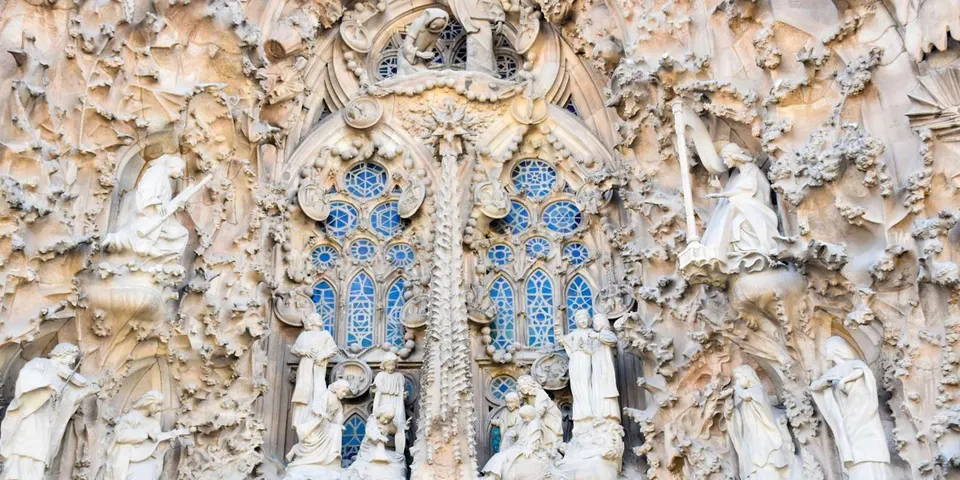
It faces east, so the morning sun reaches it first. Its theme is the birth of Christ and, more broadly, the joy and abundance of life, which is why it overflows with plants, flowers, fruit, birds, reptiles, insects, farm animals, biblical figures and carved foliage. The whole façade behaves like an ecosystem, and the Basilica describes it as a celebration of life and of divine creation.

Why are there so many animals?

Because Gaudí wasn't using nature as background decoration. For him, the natural world itself takes part in celebrating Christ's birth. Look closely and you can find ducks, hens and other birds, amphibians, insects and many Mediterranean plants. The density is deliberate: birth means life, and in Gaudí's visual language life appears everywhere.

The three Nativity portals

The façade has three portals. From left to right they are Hope, linked above all with Joseph; Charity, the central portal, linked with Jesus and the Holy Family; and Faith, linked with Mary. Together they stand for the three theological virtues, Faith, Hope and Charity. If the façade first looks like an unreadable mountain of sculpture, use those three portals as anchors.

The Tree of Life

One of the easiest features to spot is the tall green structure near the centre of the façade. It looks like a cypress: this is the Tree of Life. The cypress has long been associated with eternity, and the white doves around it reinforce the meaning. Its strong colour is a reminder that Gaudí did not imagine architecture as beige stone. He loved colour, and many exterior elements were designed to stand out vividly against the masonry.

Fruit on the towers

Look at the pinnacles and you'll notice colourful clusters that look like fruit. They aren't random either. Fruit and crops appear again and again as symbols of abundance, life, the seasons and the Eucharist; wheat and grapes are the most direct, standing for bread and wine. Many of these colourful pieces use trencadís, mosaic made from broken ceramic or glass, a Gaudí hallmark.
Passion Façade

Passion façade: deliberately harsh

Walk round to the Passion side and the mood changes at once. Where the Nativity façade feels soft, crowded and organic, this one is angular, stripped back, skeletal, severe and uncomfortable. That is intentional.

Its subject is the last days, suffering and crucifixion of Christ, and Gaudí wanted the architecture itself to make you feel fear and anguish as well as show a sequence of events. The huge leaning columns look like bones or tensed muscles, large areas are left fairly bare, and deep shadows become part of the composition.

Did Gaudí sculpt the Passion façade?

No. The sculptures most visitors associate with it were made much later by Josep Maria Subirachs, who was commissioned in 1986. His style is radically different from the naturalistic carving of the Nativity: faces become geometric, bodies hard and angular, lines exaggerated, and some figures look carved from giant wedges. That contrast is one reason the façade has been controversial. Dismissing it as "not Gaudí enough" misses the point, though. Subirachs deliberately created a modern visual language for the harsh subject of the Passion, and the Basilica describes the figures as intentionally hard and severe, reflecting pain and death.

Why do the Passion sculptures look so modern?

Because they are. The façade's architecture comes from Gaudí's project, but Subirachs' sculpture belongs to the late 20th century. It is a reminder that Sagrada Família is not one frozen historical object: it holds work from Gaudí's lifetime, his immediate successors, later 20th-century architects, today's engineers, sculptors, stained-glass artists and craftspeople. You are looking at generations of artistic interpretation in one building.

How to read the Passion façade

The story follows an S-shaped route, starting low down and moving upwards through Christ's last days. Follow the sequence instead of trying to take in the whole façade at once. The main scenes include:

  • the Last Supper
  • Judas
  • Peter's denial
  • the trial before Pilate
  • carrying the cross
  • the crucifixion
  • the burial
  • the resurrection

The Basilica itself describes this S-shaped path. Without knowing it, the sculpture groups can seem far more random than they are.

The magic square

Near the Passion scenes is a 4 × 4 number square whose rows and other combinations add up to 33, traditionally Christ's age at the crucifixion. It is easy to miss unless you know to look, and one of the most popular hidden-detail stops on guided tours.

The resurrection above

The façade doesn't end with death. Higher up, the upper gallery carries symbolism linked with the prophets and the risen Christ, and the façade includes an empty tomb, vegetation standing for life after death, and a prominent cross above. The story rises: suffering below, resurrection drawing the eye upwards.

Glory Façade

Glory façade: the grand entrance still being built

The Glory façade is the least familiar to visitors because it is still part of the construction programme. Architecturally, it is meant to become the main entrance and the most monumental of the three.

Its theme isn't one event in Christ's life but something much broader: the human path towards God. Visitors approaching the main entrance will move, symbolically, through ideas about earthly life towards salvation, which makes the façade a kind of theological map. Its planned symbolism includes:

  • baptism and penance
  • the Beatitudes
  • the seven sacraments
  • the Lord's Prayer
  • the seven deadly sins and the corresponding virtues
  • the gifts of the Holy Spirit
  • creation and angels
  • the Last Judgement and eternal glory

Why this part of the story is still changing

The Glory façade is likely to become one of the most important parts of the finished Basilica. It is also why a guide to the architecture needs updating over time: this side is still taking physical shape. Our guide to when Sagrada Família will be finished covers where the work stands.

18 Towers

Why does Sagrada Família have 18 towers?

The tower count is one of the clearest examples of Gaudí turning theology into architecture. The complete design calls for 18 towers arranged in a hierarchy, and the hierarchy shows in their heights.

TowersNumberRepresent
Apostle towers12The twelve Apostles
Evangelist towers4Matthew, Mark, Luke and John
Virgin Mary tower1Mary
Jesus Christ tower1Jesus
Total18

Jesus is tallest, Mary comes below him, the Evangelists surround Jesus and the Apostles form the outer group around the façades. The skyline is effectively a religious diagram.

The Tower of Jesus Christ

At the centre stands the Tower of Jesus Christ. Its exterior was completed in February 2026, bringing Sagrada Família to its full height of 172.5 metres, higher than every other tower. It is crowned by a huge four-armed cross, and its symbolism presents Christ as the centre of the Christian story, the Lamb of God and the light of the world; the cross also carries lighting directed to the four cardinal points. The whole exterior composition builds towards this one point.

Why 172.5 metres?

The tower was deliberately kept below the height of nearby Montjuïc, which is usually explained by Gaudí's belief that human architecture should not surpass God's creation. Whether you see that religiously or architecturally, the effect matters: Gaudí wasn't trying to win a skyscraper contest. The tower had to dominate the church, not the landscape.

The Tower of the Virgin Mary

The tower above the apse represents Mary. It reaches 138 metres and is crowned by a large 12-pointed star, now one of the most recognisable recent additions to Barcelona's skyline. Its position matters too: it stands above the apse, not in the central crossing, close to the Jesus tower but on a lower level of the hierarchy.

The four Evangelist towers

Four towers of about 135 metres surround the Tower of Jesus Christ. Each is topped by its Gospel writer's symbol: Matthew, a man or angel; Mark, a lion; Luke, an ox; John, an eagle. Together these symbols are the tetramorph of Christian art, and once you know them the newest central towers are easy to tell apart from the street.

The twelve Apostle towers

The lower outer group represents the twelve Apostles, with four towers on each of the three great façades. The symbolic structure radiates outwards: Jesus, then the Evangelists and Mary, then the Apostles, then the world. Our towers guide explains which of them you can actually go up.

Why do the towers have holes in them?

Look closely and the bell towers are far from solid stone needles. Their many openings reduce weight, let the wind pass through, make room for bells and give the towers their perforated look, which makes them seem lighter than their size suggests. Gaudí was always after height without the feel of a massive stone block.

Upward

Why are the Sagrada Família towers shaped like that?

The towers taper sharply towards their pinnacles. The Basilica describes their overall shape as parabolic, which helps both their structural stability and the impression of rising towards heaven.

That upward movement is one of the building's strongest themes. Almost everything sends your eyes higher:

  • columns and branches
  • façade portals
  • pinnacles and towers
  • light wells
  • the central vaults

Why does nature appear everywhere?

Gaudí is often summed up as saying that nature was his teacher. More precisely, nature shaped Sagrada Família on three levels. Structure: trees inspire the branching columns, and natural load paths the inclined supports. Geometry: Gaudí recognised complex geometric forms in natural objects and used similar principles for his surfaces. Symbolism: plants, animals, fruit and the seasons are woven into the Christian story. So a frog or a bunch of grapes is rarely a whimsical aside; it can be natural observation, architecture and symbolism at once.

Reading the Building

Why doesn't Sagrada Família look symmetrical?

At the large scale the building is far more ordered than it first appears, and the plan is highly structured. In the details, though, Gaudí often avoids repetition. A tree can be balanced without every branch being identical, and Sagrada Família likewise combines strong underlying geometry, a careful hierarchy and enormous decorative variety. The result feels organic, not mechanical.

From several blocks away

You see the towers, the silhouette and the vertical hierarchy.

From across the street

You see the façades, the portals and the large sculpture groups.

From a few metres away

Another layer appears: plants, animals, inscriptions, saints, geometric patterns, fruit, faces, tools and numbers.

That is why a 15-minute photo stop outside doesn't do the building justice: there is too much to take in at one glance.

Words, Doors and Sound

The details that are easy to walk past

Inscriptions are part of the architecture

Words appear all over Sagrada Família, and they aren't labels added afterwards. Gaudí worked religious text into façades, doors, towers, vaults, pinnacles and sculpture, and repeated words such as Sanctus, Hosanna, Amen and Alleluia become ornament in their own right. The line between text, sculpture and structure blurs.

Stop at the doors

Visitors understandably hurry towards the interior. Don't. Some of the doors are among the best places to see how contemporary artists carried on the symbolism. On the Passion side, Subirachs set words and biblical text directly into monumental bronze surfaces; on other entrances, foliage and natural imagery are carved in deep relief. Sagrada Família rewards slow looking more than checklist sightseeing.

Gaudí designed sound as well as light

He placed choir areas at raised levels around the nave so that singing could surround the congregation, and the hyperboloid vaults help reflect and carry sound. The Basilica's architects describe his aim as an enveloping musical experience in which voices fill the church. The nave was designed for sight, light, sound, movement and worship.

The Apse

Why does the apse look different?

The apse sits behind the altar at the northern end of the church and is among the earliest parts of the project, so its architecture links Gaudí's beginnings with his later structural ideas. Inside, your eye is drawn up to an enormous hyperboloid; the apse reaches about 75 metres at its highest point, and its decoration includes gold mosaic and symbolism of the Holy Trinity.

Easy to overlook

Everyone tends to stare at the nave columns, but the apse is one of the most structurally revealing areas inside. Give it a few minutes before you head down the nave.

Gaudí and After

Is all of Sagrada Família designed by Gaudí?

Not in the simple sense. Gaudí set the architectural programme, the structural systems, the overall symbolism and many detailed models, but he died in 1926.

Later generations have had to:

  • reconstruct damaged models
  • interpret incomplete information
  • solve modern engineering problems
  • design technical systems
  • create sculpture and stained glass
  • turn Gaudí's geometry into buildable structures

UNESCO draws the line explicitly: the parts of Sagrada Família built by Gaudí himself, and listed, are the Nativity façade and the crypt, while later construction continues the wider project he conceived. That doesn't make the rest "fake Gaudí". It makes the building more interesting than a one-architect story. Our Sagrada Família history covers who built what, and when.

Why do the Nativity and Passion façades look like different buildings?

Because in several ways they are. They differ in subject, construction period, sculptors, artistic language, orientation and emotional intent. The Nativity is life, birth, nature and joy, dense and organic. The Passion is death, sacrifice and suffering, bare and angular. Later artists let those contrasts show instead of making every surface match, which is why walking round the building can feel like moving through different centuries.

If you are deciding which side to climb, our Nativity or Passion tower guide compares the two.

On Your Visit

The architectural details to notice on your visit

If you don't want to memorise the whole page, remember these.

Outside: the Nativity façade

Look for the three portals of Faith, Hope and Charity, the animals hidden in the sculpture, the vegetation, the Tree of Life, the colourful fruit and the four Apostle towers. Then remember that this is the façade Gaudí knew best.

Inside: stand in the centre and look up

Don't just photograph down the nave. Stand under the central area and trace the line from column to branch to vault to opening to light. It makes Gaudí's structural logic much easier to follow.

Inside: compare the two colour zones

Turn to the Nativity side and notice the cooler glass, then turn to the Passion side and notice the warmer glass. It is one of the clearest pieces of symbolism you can grasp without any religious background.

Outside: the Passion façade

Look for the skeletal columns, Subirachs' angular figures, the S-shaped sequence, Judas, Peter's denial, the crucifixion, the number square and the resurrection imagery above. Don't expect it to resemble the Nativity; the difference is the point.

From outside: the tower hierarchy

Find, in order: the central Jesus tower, the Mary tower with its star, the four Evangelists and the lower Apostle towers. Once you see that structure, the skyline stops looking like a random collection of spires.

Where to stand

For the columns, stand near the centre of the nave and look straight up. For the stained glass, look across the church, not at the windows: the colour falling on the opposite columns is often more striking. For the Nativity, cross to Plaça de Gaudí for the wide view, then come closer for the sculpture. For the Passion, step well back first; its skeletal architecture reads best as one composition.

Ten Symbols

10 Sagrada Família symbols most visitors miss

SymbolWhat it tells you
1. East and westNativity is sunrise, Passion is sunset: the movement of the sun is part of the story
2. The forestThe columns don't just resemble trees; they work like branching trees
3. Tower heightsHeight shows the religious hierarchy, with Jesus highest
4. Evangelist animalsLion for Mark, ox for Luke, eagle for John, a man or angel for Matthew
5. FruitAbundance and creation; wheat and grapes also evoke the Eucharist
6. The Passion number squareIts combinations total 33, traditionally Christ's age at his death
7. Colour directionBlue and green on the eastern Nativity side, red and orange on the western Passion side
8. The cypressThe Nativity's Tree of Life stands for eternity
9. Upward movementAlmost every major element pushes your eye higher
10. Different stone coloursThey show different building periods, not one artificially uniform surface

Guide or Not?

Do you need a guided tour to understand the architecture?

Not necessarily. You can enjoy Sagrada Família knowing nothing about hyperboloids, Christian iconography, Catalan Modernisme or structural engineering; the building works on you straight away. But this is a monument where explanation adds an unusual amount.

Without context, you seeWith context, you see
A strange towerOne of the four Evangelists, identified by the tetramorph
A blue windowDawn-coloured light on the Nativity side
An odd branching columnA structural tree doing the job of a Gothic buttress
Random sculpture groupsAn S-shaped Passion story

That is why a good guide is especially useful here. It isn't about historical trivia; a guide teaches you how to read the building. The Priority Access Guided Tour concentrates on Gaudí's details and the museum's sketches, which suits an architecture-first visit. Before booking, compare standard entry with a guided tour, and check whether a tower is included.

Our pages on official tickets vs guided tours and whether a guided tour is worth it weigh a guide against the audioguide.

Short on Time

If you only have 10 minutes to study the architecture

Do this, and you'll understand more of Gaudí's architecture than from a hundred photographs.

Minutes 1 to 3: the Nativity

Stand across the street and take in the whole composition. Then zoom in: tower, portal, sculpture, plant, animal.

Minutes 4 to 6: the nave

Go inside and stop roughly on the central axis. Look straight up and trace how the columns divide.

Minutes 7 and 8: the colour

Look east, then west, and compare the stained glass.

Minutes 9 and 10: the Passion

Walk round to the Passion façade. Ignore the detail at first and look only at the big architectural bones, then compare them with the Nativity you just saw.

The Big Idea

The best way to think about Sagrada Família

Don't think of it as a church with symbols added. Think of it as a symbolic system that became a building.

Nature becomes structure, and structure becomes theology. Sunlight carries the story, tower height shows the hierarchy, colour follows the time of day, sculpture tells the narrative, and geometry makes the whole thing physically possible.

The quantity of decoration is not what makes Sagrada Família extraordinary. So many different parts of the building express the same ideas at once.

FAQ

Sagrada Família architecture: frequently asked questions

Who designed Sagrada Família?

Francisco de Paula del Villar was the original architect when construction began in 1882. Antoni Gaudí took over in 1883 and transformed the project into the basilica you see today.

What style is Sagrada Família?

It is most closely associated with Catalan Modernisme, although Gaudí combined Gothic principles, natural forms, religious symbolism and new geometry into a very personal architectural language. UNESCO describes his work as a synthesis that goes beyond any single conventional style.

Why does Sagrada Família look unfinished or irregular?

Partly because it has been built across several generations, so different areas belong to different periods and artists. Work also continues on the Glory façade and other remaining parts.

Why are the columns shaped like trees?

Their branching structure carries the loads of the roof and towers down towards the foundations, and it creates an interior inspired by a forest.

What are the three Sagrada Família façades?

The Nativity façade (birth and life), the Passion façade (suffering and death) and the Glory façade (salvation and humanity's path towards God).

Which façade did Gaudí design?

Gaudí conceived all three, but the Nativity façade is the one built during his lifetime, and he personally supervised much of it. It and the crypt are the parts of Sagrada Família included in UNESCO's World Heritage listing.

Why is the Passion façade so different?

Its severe architecture and later sculpture deliberately reflect suffering and death. Josep Maria Subirachs, commissioned in 1986, created the main sculpture in an angular modern style, without imitating the Nativity façade.

Why does Sagrada Família have 18 towers?

They represent the 12 Apostles, the four Evangelists, the Virgin Mary and Jesus Christ. The tower of Jesus stands in the centre and is the tallest.

How tall is Sagrada Família?

The Tower of Jesus Christ reaches 172.5 metres. Its exterior was completed in February 2026.

Why isn't Sagrada Família taller than Montjuïc?

Gaudí deliberately kept the church below the height of the hill, usually explained by his belief that human work should not surpass God's creation.

Is Sagrada Família Gothic?

It has strong Gothic roots and keeps the basic layout of a large Christian church, but Gaudí replaced key Gothic structural conventions, such as flying buttresses, with his own system of branching columns, inclined supports and ruled geometry.

Is all of Sagrada Família a UNESCO World Heritage Site?

No. The parts of Sagrada Família included in UNESCO's Works of Antoni Gaudí listing are the Nativity façade and the crypt.

Do you need a guided tour to understand the architecture?

No, the building works on you without any background. But a good guide shows you how to read it: which tower is which, why the glass changes colour and where the Passion story starts.

Want someone to point all this out?

Sagrada Família is one of the Barcelona sights where a good guide changes what you notice: the Passion sequence, the tower hierarchy and the geometry overhead. Compare standard entry with a guided tour, and check whether tower access is included before you book.