The Basilica Interior

Inside Sagrada Familia: what you'll see in the Basilica

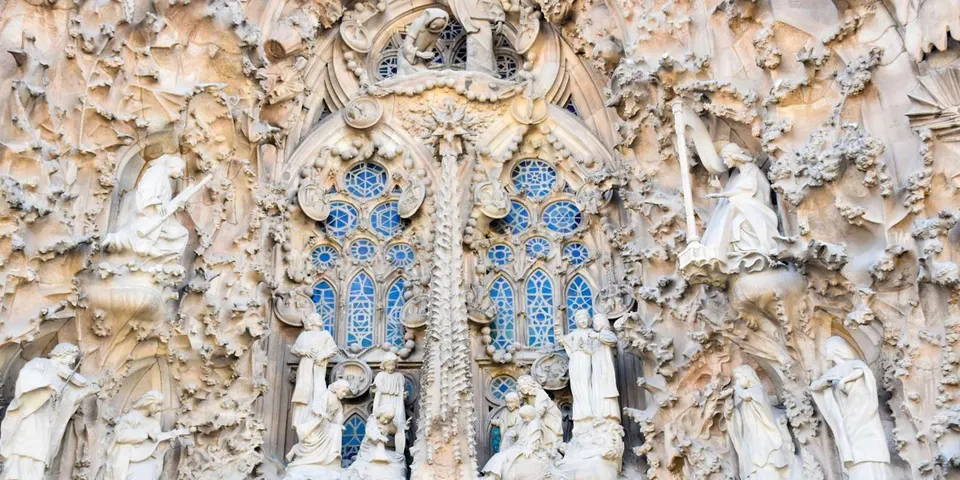
The façades get most of the photographs, but the interior is the part of Sagrada Família that surprises people most. Step through the doors and the dense stone sculpture outside gives way to a vast, bright space of branching columns, pale stone and geometric vaults, with stained glass throwing pools of blue, green, red and orange across the floor. It feels less like a Gothic cathedral than a walk into a stone forest.

Updated October 2026

Branching columns and vaults inside the Sagrada Familia Basilica in Barcelona

Allow for the interior

60–90 minutes Central nave 45 m high

The forest comparison is not accidental. Gaudí designed the columns to branch at different heights and carry the weight of the roofs and vaults down to the foundations, which let him do without the flying buttresses of Gothic cathedrals. The Basilica's own architectural documentation calls these columns "structural trees".

If you can choose your entry time, think about the light. Morning sun comes in from the east, through the cooler blue and green glass on the Nativity side. Later in the day the western Passion side glows with reds and oranges. The effect also changes a great deal with the season and the weather.
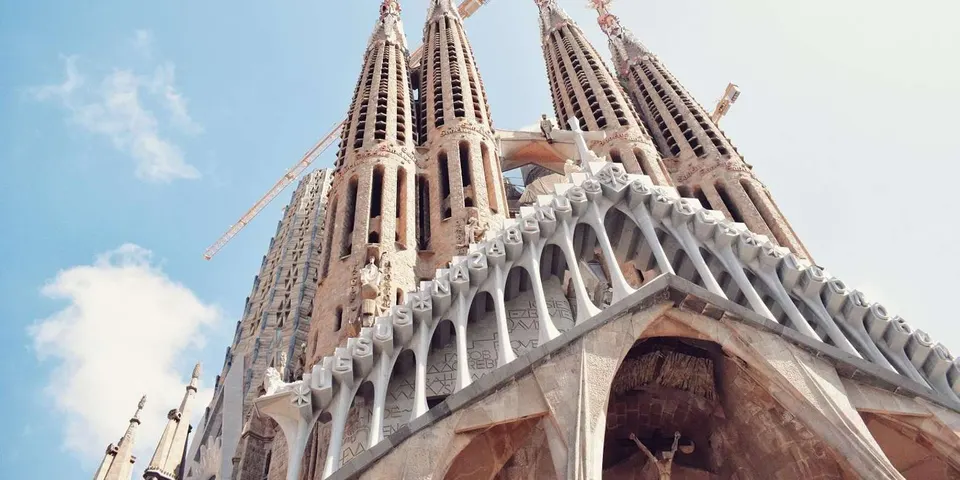
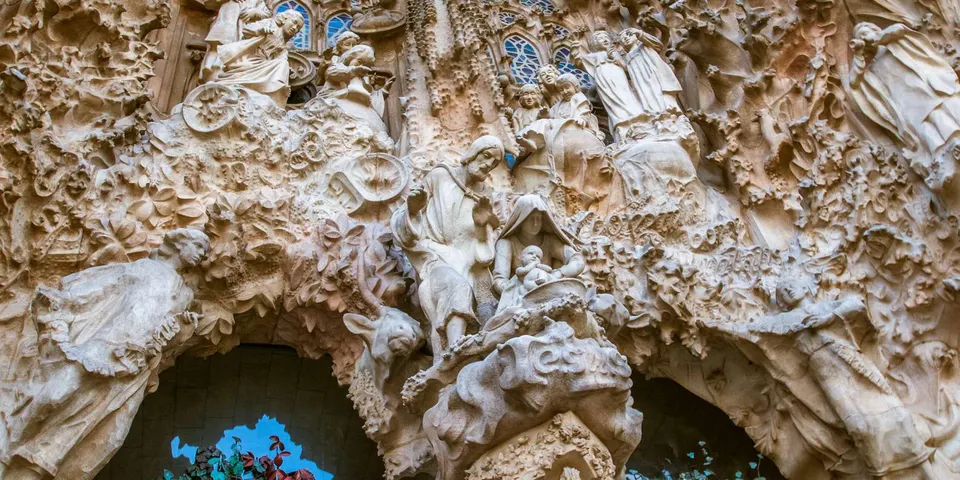
Our quick take: don't visit Sagrada Família just to photograph the façades. The interior is the main reason to buy a ticket. Give yourself at least 60–90 minutes inside, look up before you reach for your phone, and watch how the light changes from the cool Nativity side to the warm Passion side.

Basilica Entry

Check entry tickets for your date

Every standard ticket takes you into the nave, the stained-glass light and the museum. On GetYourGuide, the Entry Ticket with Audio Guide is the timed Basilica entry with the official app, rated 4.6/5 from 120,755 reviews, from £29, with free cancellation up to 2 days ahead.

Pоwered by GetYourGuide

First Visit

Sagrada Familia interior: what to look for first

If this is your first visit, these are the details we would make sure you don't miss.

  1. The branching columns, Gaudí's stone forest.
  2. The coloured stained-glass light, cool on one side and warm on the other.
  3. The ceiling and hyperboloid vaults: look straight up.
  4. The central nave, one of the best perspectives inside.
  5. The altar and the suspended Christ in the apse.
  6. The columns' changing materials and colours.
  7. The crossing beneath the central towers.
  8. The inscriptions and symbolic details around the interior.
  9. The organ and the choir galleries.
  10. The museum, especially if you want to know how Gaudí designed the building.

Don't treat it as a checklist

Sagrada Família works better if you stop moving every so often. Stand in the nave, look up and let the space make sense before you hunt for individual details.

The Big Idea

Why does the inside of Sagrada Familia look like a forest?

This is the most important idea behind the interior. Gaudí did not decorate ordinary columns to look like trees. The tree shape is structural.

Most of the columns lean slightly; few stand perfectly vertical. Higher up they divide into branches, which spread the loads of the vaults, roofs, windows and central towers before carrying that weight down to the foundations. The Basilica's documentation describes the system as a series of tree-like structural columns branching at different heights.

That makes the interior far more interesting to look at. The forest is not a picture laid over an engineering system: the engineering itself makes the forest.

Look at where the columns split

When you first walk in, your eye goes to the stained glass. After that, look closely at the columns and follow one upwards. Instead of running as a single shaft to the ceiling, it reaches a knot and then branches, spreading the load above like the limbs of a tree holding up a canopy.

Walk around the nave and you will notice that the columns don't all branch at the same height. That is part of why the ceiling seems alive, with no rigid grid holding it up.

Other Experiences You Might Enjoy

More Gaudí interiors in Barcelona

If the branching columns win you over, Gaudí's houses show the same ideas at a smaller scale: the bone-like balconies and light well of Casa Batlló and the rooftop chimneys of La Pedrera (Casa Milà) on Passeig de Gràcia, plus the mosaic terraces of Park Güell. Gaudí architecture tours, Park Güell tickets and Barcelona city tours that include the Gothic Quarter are below.

Scale

How tall is the Sagrada Familia interior?

The heights rise in steps. According to the Basilica's interior guide, the main heights are multiples of 7.5 metres.

Interior elementHeight
Choir level15 m
Side naves30 m
Central nave45 m
Crossing60 m
Apse75 m

Inside, the Basilica is about 90 metres long.

What matters is what those numbers do as you walk. The vaults get higher as you approach the most important liturgical areas, so you feel the space opening upwards as you move through the church.

Light and Colour

The stained glass: why Sagrada Familia looks different through the day

The stained glass does more than make the church colourful. Gaudí used the direction and movement of sunlight as part of the architecture, and the colours change across the Basilica with the orientation of each wall.

Nativity side: blues and greens

The Nativity façade faces east, the side linked with sunrise, birth, beginnings and the Nativity of Christ. Its stained glass uses mostly cooler tones, particularly blues and greens, and the morning sun comes in from this direction.

Passion side: reds and oranges

The Passion façade faces west, the side linked with sunset, Christ's death and the Passion. The glass here is much warmer, dominated by reds, oranges and yellows, and as the sun moves west in the afternoon these colours can become especially intense.

Coloured light from the Sagrada Familia stained glass windows falling on the columns

Timing

What is the best time to see the stained glass?

There is no single perfect time, because the effect depends on the season, the cloud cover, the angle of the sun, where you stand inside and which colours you prefer. There are useful patterns, though.

Time of dayStrongest lightWhat you'll notice
MorningNativity side (east)Rising sun through the cooler blue and green glass
AfternoonPassion side (west)Warmer reds and oranges as the light moves round
Late afternoonPassion side (west)When conditions cooperate, some of the most dramatic warm light inside

None of that means you should turn down an 11:30 ticket because someone online said 16:30 is "the best". Barcelona's weather doesn't follow sightseeing schedules: a bright morning can be spectacular, and an overcast late afternoon can be quite subdued.

Summer vs winter light

The season matters more than many visitors realise. The Basilica's own research notes that the coloured light is especially intense around the summer and winter solstices, because of the angle at which sunlight reaches the windows. Around the summer solstice, early eastern light can strongly light the Nativity side. Around the winter solstice, the lower setting sun reaches the Passion windows more directly and throws strong warm colours across the interior.

So winter is not a bad time for the stained glass. It can bring some of the richest warm light of the year.

Easy to Miss

Why are some windows almost clear, and who made the glass?

Why are some Sagrada Familia windows almost clear?

The lower windows hold the strongest colours, and higher up the glass becomes much clearer. That reverses a pattern found in many historic Gothic churches. Gaudí wanted intense colour low down, where people experience it directly, and clearer light higher up to brighten the vaults and stress their height.

So when you look towards the ceiling, notice that the building does not get darker as it rises. White natural light is being brought into the upper levels on purpose.

Did Gaudí design the stained glass himself?

Not in the form you see today. Gaudí set out how light and colour should work in the Basilica, but much of the current glass was made long after his death. The artist Joan Vila-Grau began designing stained glass for the Basilica in 1999 and worked on it for more than two decades, using leaded glass to carry out Gaudí's intentions in a huge modern basilica.

That is true of Sagrada Família generally. It is not a building Gaudí executed from start to finish: it is an ongoing project developed from his ideas, models, plans and surviving work, interpreted by later architects, artists and craftspeople.

Look Up

The ceiling may be the best part of the interior

A surprising number of visitors spend most of their time looking straight ahead. Look up instead: the ceiling is where the tree idea reaches its climax. The branching columns spread into a canopy of geometric vaults, with openings that bring extra daylight into the Basilica.

Gaudí used hyperboloid geometry to create skylights between the columns, and the Basilica's interior documentation counts 289 skylights bringing light in from above. That is one reason the church feels so much brighter than many old European cathedrals.

What is a hyperboloid, and why should you care?

You don't need an architecture degree. A hyperboloid is a curved geometric surface, and Gaudí used it for openings and vaults because it let him combine:

  • structural efficiency
  • natural light
  • organic-looking forms
  • geometry that could actually be calculated and built

In practice, those star-like openings overhead are not random decoration. They help hold the building up and bring daylight deep into the interior.

Structure

Why did Gaudí reject Gothic flying buttresses?

Gaudí admired Gothic architecture but thought its structure could be improved. Traditional Gothic cathedrals rely on external buttresses and flying buttresses to resist the sideways push of their vaults, which Gaudí saw as an imperfect solution.

At Sagrada Família he developed an internal system of inclined, branching columns that sends the loads down through the structure. That greatly reduced the need for huge supports outside, and it is one reason the inside feels so open.

Why are the columns different colours?

They are not all made from the same stone. Look closely and you will see columns ranging from pale grey to dark grey and reddish tones. The materials include:

  • granite
  • basalt
  • porphyry
  • reinforced or prefabricated concrete

They vary partly because different columns carry different loads. The Basilica's 2024 colour guide picks out light-grey granite and concrete, dark basalt and reddish porphyry among the materials in the nave, and the variety adds to the sense of walking among different tree trunks.

The Apse

The altar, the suspended Christ and the crossing

The altar and apse

Eventually, pull your eyes away from the columns and look towards the apse, the liturgical heart of the Basilica. The presbytery is raised about two metres above the floor and framed by twelve columns.

The main altar is a huge block of porphyry about 2.72 metres long, weighing about 7,500 kg. For all the complexity around it, the altar is strikingly plain, and the contrast is deliberate.

Look above the altar

Suspended over the altar is a crucified Christ by the sculptor Francesc Fajula. It hangs from a seven-sided baldachin about five metres across, a design that echoes a baldachin Gaudí made for Mallorca Cathedral.

Look past the sculpture and up into the apse. The Basilica's religious programme links the altar, apse and towers above as parts of one symbolic composition.

The crossing: stand underneath it

The crossing is where the main nave meets the transept. Stop here for a minute: the vault rises to about 60 metres, and above it sits the structure that carries the central towers.

The recently built Crossing Room higher up takes light through 25 skylights, while the massive columns below branch out to support the central tower complex. Standing here gives you the clearest sense that the interior and the towers are one enormous structure.

Construction

Is the Sagrada Familia interior finished?

The main nave has been enclosed and used for worship since Pope Benedict XVI dedicated it in 2010, but Sagrada Família as a whole is still an active construction project. Work has continued on:

  • the central towers
  • the Glory façade
  • the Chapel of the Assumption
  • sections of the cloister
  • related architectural elements

The Glory façade, which will become the main entrance, is still to come, so the building as a whole is some years from completion.

The interior you visit is a working consecrated basilica, not an unfinished shell. Construction elsewhere on the site can still affect views, routes and which areas are open on the day.

Music

The choir galleries and the organ

The choir galleries

Look above the side naves and you will see raised galleries meant for choirs. Gaudí wanted music to surround worshippers from several directions, and the choir spaces sit roughly 15–20 metres above the floor. According to the Basilica, the hyperboloid vaults also help reflect and project sound through the church.

Even when no choir is singing, knowing this explains why the galleries are where they are.

The organ

The organ is part of the presbytery and was built by the Blancafort workshop in Collbató. You may not hear it on an ordinary visit, but Sagrada Família is more than an architecture museum. It is an active Catholic basilica designed for Mass, prayer, music and religious ceremony, and much of the interior only makes full sense once you remember that.

Gaudí's Tomb

Is Gaudí buried inside Sagrada Familia?

Yes. Gaudí is buried in the crypt beneath the Basilica, in the Chapel of Our Lady of Mount Carmel. The crypt is older than most of the main Basilica and was one of the first parts of the church to be finished.

Don't assume an ordinary sightseeing route gives you access to every part of the crypt. Access depends on religious use and current visitor arrangements, so if seeing Gaudí's tomb matters to you, check the current conditions before you go; it is not a guaranteed stop on the normal route.

Is the crypt included with a Sagrada Familia ticket?

The tourist visit focuses on the Basilica itself, the museum and the areas on the current visitor route. The crypt remains an active religious space, and its access arrangements can differ from ordinary sightseeing.

A Sagrada Família ticket is a tourist visit to the Basilica, not unrestricted access to every liturgical or architectural area of the complex. Routes can also change for worship, construction, maintenance and special events, and the Basilica reserves the right to alter itineraries or close spaces when needed.

Gaudí's Methods

Don't skip the Sagrada Familia museum

After an hour of finished architecture, the museum shows how on earth it was designed. It is especially rewarding if you are interested in Gaudí's working methods. Instead of relying only on flat drawings, he used:

  • physical models
  • geometric experiments
  • hanging-chain models
  • photographs
  • three-dimensional design methods

Once you have seen the real columns and vaults, models that might have looked technical suddenly make sense. Allow at least 15–30 minutes if architecture interests you.

Where is the museum?

The museum is part of the Sagrada Família visit and you explore it on your own. If you take an official guided tour, the museum is not normally covered in the guided part, so don't leave when your guide finishes. Carry on along the visitor route and see it yourself: it gives the history behind what you have just seen overhead.

Prefer a guide inside? The Skip-the-Line Entry Ticket & Tour includes admission and about 1.5 hours with an official guide (4.8/5 from 15,193 reviews, from £60), and the English-language Priority Access Guided Tour costs a little less (4.8/5 from 6,344 reviews, from £55).

Architectural models in the Sagrada Familia museum

Photography

Can you take photos inside Sagrada Familia?

For ordinary visitors, personal photos are generally fine, but professional and commercial photography is restricted. The Basilica's rules ban professional photo, video and audio equipment without prior permission, and commercial, advertising or professional use of images without authorisation. Tripods also need accreditation.

With a phone or a normal camera, the practical advice is simple:

  • don't bring a tripod
  • don't stage a professional photo shoot
  • don't block other visitors
  • remember you are inside a working church

Can you use a tripod?

No, not as an ordinary visitor: tripods need prior accreditation. For most visitors a modern phone or a handheld camera is plenty, because the interior has so much natural light.

Photo Tips

How to photograph the Sagrada Familia interior

The biggest challenge is the huge difference in brightness between the stained glass and the darker stone. A few simple approaches work well.

Don't shoot only the windows

Expose purely for the stained glass and the rest of the interior can turn very dark. Include some columns or architecture around the glass.

Look for coloured light on the columns

Often the best photo is not the window itself but the red, orange, blue or green light falling on pale stone elsewhere in the Basilica.

Shoot vertically

The building pulls your eyes upwards, and portrait orientation often captures it more naturally than a wide horizontal frame.

Step back and turn round

The most dramatic columns often need more space than you expect, and the view behind you can beat the obvious forward-facing shot.

Put the phone down sometimes

This isn't sentimental advice. The building is too complex to understand entirely through a screen, so give yourself five minutes without taking a single photo.

Light and Weather

Is it dark inside, and what happens on a cloudy day?

Is it dark inside Sagrada Familia?

Usually not, and that is one of the biggest contrasts with many historic European churches. Gaudí deliberately built a structure that could take in a huge amount of natural light. The branching columns freed the walls from much of their load, leaving room for large windows, while hundreds of openings overhead bring more light into the vaults. On a bright day the nave can feel remarkably luminous.

What happens on a cloudy day?

Don't worry if Barcelona isn't sunny. You won't get the same intense beams of coloured light, but the glass and the interior are still impressive. Cloud can even make stone details easier to see, the lighting more even and photos less contrasty. Sun transforms the Basilica, but you don't need it to enjoy the visit.

Is It Worth It?

Is Sagrada Familia worth going inside, even without a tower?

For a first visit, yes. If your Barcelona budget makes you choose between seeing the outside for free and buying a Basilica ticket, we would put the money on the interior. The façades are astonishing and you can see them from the public streets, but they don't prepare you for the change inside: dark sculpted stone gives way to light, colour and enormous open space. Judging Sagrada Família from exterior photos alone gives a misleading idea of the building.

The towers are an optional add-on, and the nave is the essential Sagrada Família experience. A tower gives you unusual architecture and views, but the interior is where the building's central ideas are clearest. Our Sagrada Família towers guide covers how the tower visit works if you are weighing it up.

You are not missing the core of the Basilica if you skip the tower because of…

  • vertigo
  • limited mobility
  • claustrophobia
  • young children
  • limited time
  • no tower availability on your date

Timing

How long should you spend inside Sagrada Familia?

45–60 min

Quick visit

Enough for the nave, the main architectural features and some photos.

60–90 min

Comfortable visit

Our choice for most first-time visitors.

1½–2 hours+

Architecture enthusiast

Especially if you use the full audioguide and spend real time in the museum.

Add extra time if your ticket includes a tower. And don't assume that a 45-minute audioguide means the whole visit should last 45 minutes.

Suggested Route

What is the best route through the interior?

You don't need a military sightseeing plan, but this sequence works well.

  1. Stop shortly after entering. Don't start listening, photographing and walking all at once: look across the whole nave first.
  2. Take in the Nativity-side light and its cooler colours.
  3. Follow one column upwards and find where the shaft branches.
  4. Walk to the crossing and look straight up when you reach it.
  5. Pause in front of the altar to see the Christ, the baldachin and the apse.
  6. Cross to the Passion side and compare its warmer glass with the Nativity side.
  7. Walk back through the nave for the reverse perspective.
  8. Visit the museum after the architecture, not before, so the models are easier to understand.

Best places to stand inside Sagrada Familia

There isn't one single viewpoint, but we particularly like these:

  • Centre of the nave: the best overall view of columns, ceiling and altar.
  • Near the crossing: the best sense of vertical scale.
  • Nativity side in the morning: the best chance of strong cool-coloured light.
  • Passion side later in the day: the best chance of strong orange and red light.
  • Looking back along the central nave: often overlooked.

Sound

What to listen for, and the 9–10 am quiet hour

Even on a normal sightseeing day, Sagrada Família has an interesting acoustic. Gaudí built in raised choir galleries and designed the interior with liturgical music in mind, and the Basilica's architects have explained that the vault geometry helps carry singers' voices through the space. It also means visitor noise travels, so keep your voice low.

The 9–10 am quiet hour

Since 2 February 2026, the Basilica has set aside 9:00–10:00 am every day as a quiet hour for prayer and contemplation. Visits still run during this hour, but:

  • visitors must stay quiet
  • earphones are required for the audioguide and any other audio
  • the contemplative character of the church comes first

If you want a calmer atmosphere, a 9 am visit is particularly appealing. If you are travelling with energetic young children, or want to talk about the architecture as you go, another time may suit you better.

Practical

Children, accessibility, dress code and drinks

Sagrada Familia interior with children

Children often respond well to the interior because there are obvious things to look for. Instead of explaining every symbol, ask them to find:

  • trees and branches
  • stars
  • coloured light
  • different stones
  • shapes in the ceiling
  • where blue turns into red

That turns the architecture into a treasure hunt. For very young children, a long conventional guided tour may be harder going than a self-guided visit.

Sagrada Familia interior accessibility

The main Basilica visitor areas are far more accessible than the towers. Visitors with reduced mobility can see the essential interior without climbing any tower stairs, and guide dogs are allowed for visitors who need them.

Tower access is a separate question, with much stricter physical restrictions. If accessibility matters to you, judge the Basilica interior and the tower visit as two separate experiences.

Is there a dress code inside?

Yes. Sagrada Família is an active Catholic church, and the current rules do not allow:

  • bare feet
  • see-through clothing
  • swimwear
  • trousers or skirts that don't reach at least mid-thigh
  • certain festive costumes or attention-seeking outfits

Hats are not normally allowed in the nave or the museum except for religious, health or belief-related reasons, and bare shoulders are not allowed in the Chapel of the Holy Sacrament. Check what you are wearing before you leave your hotel in Barcelona's hottest months.

Can you eat or drink inside?

No eating is allowed inside the Basilica, and the current rules keep drinks to the outdoor areas. In summer, drink plenty before you go in, because you can't walk round the nave with a bottle.

Don't Miss

What is easy to miss inside Sagrada Familia?

Even on a long visit, several details slip past people.

  • The changes in column stone. The different colours are not just the lighting.
  • The clear upper windows. Look above the brightly coloured glass.
  • The column knots, where the trunks begin to branch.
  • The choir galleries, part of Gaudí's acoustic design as well as the visual one.
  • The plain altar, much simpler than the architecture around it.
  • The reverse view. Turn round every so often.
  • The museum, especially easy to rush if you have already been inside for an hour.

FAQ

Inside Sagrada Familia: quick answers

Is the inside of Sagrada Familia worth seeing?

Yes. For most first-time visitors the interior is the best reason to buy a ticket. The branching structural columns, the scale and the stained-glass light cannot be appreciated from outside.

What does Sagrada Familia look like inside?

The nave looks like a vast stone forest. Inclined columns branch towards geometric vaults, while blue, green, red and orange stained glass fills the interior with coloured light.

Why does Sagrada Familia look like a forest inside?

Gaudí designed branching structural columns that carry the loads of the roof and vaults. The tree shape is how the building stands up, not decoration added to it.

How high is Sagrada Familia inside?

The central nave reaches about 45 metres, the crossing about 60 metres and the apse about 75 metres.

When is the best time to see Sagrada Familia stained glass?

Morning favours the cooler, east-facing Nativity side, while afternoon and evening light increasingly reaches the warmer, west-facing Passion side. The effect also changes with the weather and the season.

Is morning or afternoon better inside Sagrada Familia?

Neither is better for everyone. Choose a morning slot for cooler blue and green light, and a later slot for warmer red and orange light.

How long should I spend inside Sagrada Familia?

Allow around 60 to 90 minutes for a comfortable first visit without tower access.

Can you take pictures inside Sagrada Familia?

Personal photos with a phone or ordinary camera are generally fine. Professional equipment, tripods and commercial photography need prior authorisation.

Can you see Gaudí's tomb?

Gaudí is buried in the crypt beneath the Basilica. Access to the crypt depends on its religious use, so do not assume it is part of the standard visitor route.

Does Sagrada Familia have an altar?

Yes. The main altar is a large block of porphyry weighing about 7.5 tonnes, set in the raised presbytery in the apse.

Does Sagrada Familia have an organ?

Yes. The organ in the presbytery was built by the Blancafort workshop in Collbató.

Is Sagrada Familia dark inside?

No. Compared with many historic cathedrals the interior is very bright, thanks to its large windows and the skylights overhead.

Is Sagrada Familia still under construction inside?

The main nave is complete and has been used for worship since its dedication in 2010, but construction continues elsewhere in the Basilica.

Our Plan

What we would do on a first visit

With one standard ticket and about 90 minutes, we would:

  1. spend the first few minutes just looking around the nave
  2. compare the cool and warm sides of the stained glass
  3. follow several columns from floor to ceiling
  4. stand under the crossing and look straight up
  5. spend time at the altar and apse
  6. walk back through the nave instead of leaving straight away
  7. finish in the museum

And we would resist photographing every metre of the building. The interior makes much more sense once you stop treating it as a series of Instagram angles and start looking at how the columns, light, stone and geometry work together.

Still deciding how to book? Our Sagrada Família tickets guide compares every official ticket, and the guided tour vs ticket comparison covers when a guide is worth it.

The bottom line

Sagrada Família is famous for its towers and its detailed façades, but the inside is arguably Gaudí's most convincing trick. Outside, the building can feel dense and almost chaotic; inside, the branching columns make the structure legible, light replaces heavy masonry, blue and green give way to orange and red as you cross the nave, the ceiling opens like a canopy overhead, and the altar stays calm at the centre of it all. If you are deciding whether to pay to go in or just see it from the street, our answer is simple: go inside. Then don't rush to the altar. Stop near the entrance, put the phone away for a moment and look up.